



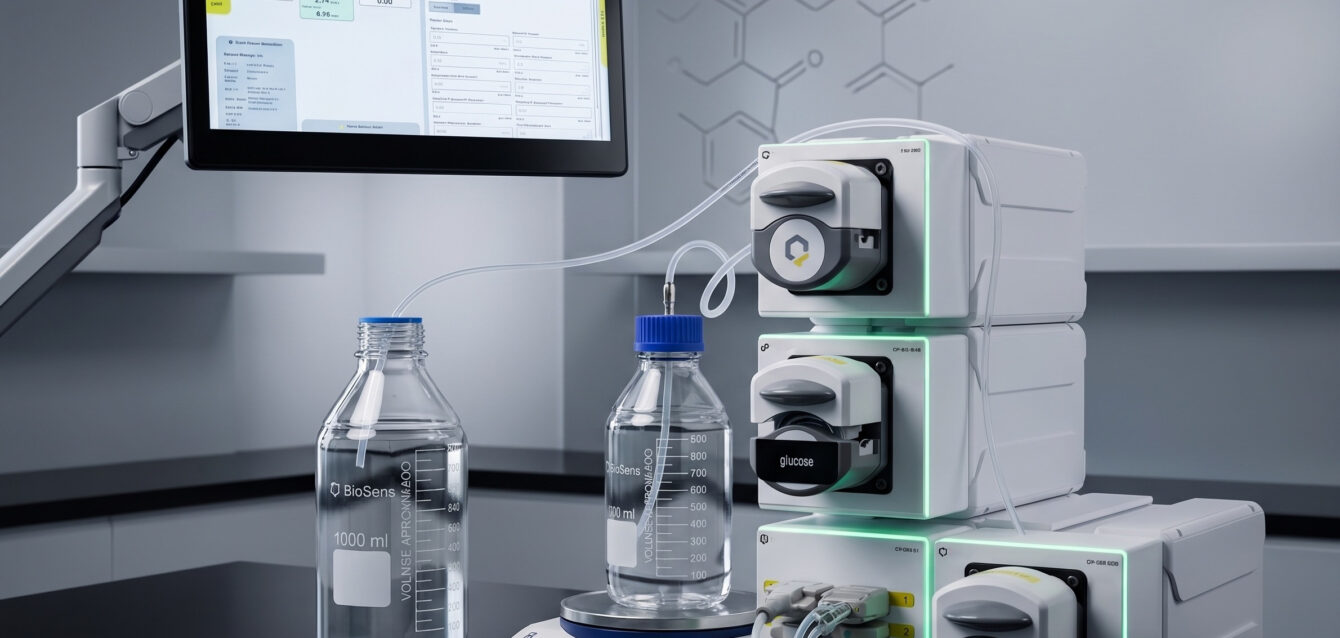
Gravimetric feeding: weekend experiment series
Gravimetric feeding sounds simple — pump liquid off a scale, weigh what's left, control the flow. In practice, it's one of the trickiest control problems in bioprocessing. We ran a weekend experiment series to find out exactly where things break.
Method
The test setup
We didn't test with water. We wanted real-world conditions:
- Fluid: 30% glucose syrup — viscous, representative of actual bioprocess feed media
- Backpressure simulation: Flow disturber installed on the discharge line to mimic real-world line resistance (filters, restrictors, bioreactor headpressure)
- Pump: QB PUMP — peristaltic pump module
- Scales: QB MULTISCALE unit — source scale (0.1 g resolution) for loss-in-weight control, destination scale (5 g resolution) for independent verification
- Controller: QB EDGE running QB Control software
- Service: pre-built gravimetric feeding service template with PID-controlled mass flow
Experiment scope:
- 6 batches with full process data (4.4M+ data points)
- Flow rates tested: 1, 2, 5, 10, 20 g/min
- Batch sizes: 100–500 g
- Longest continuous run: 8.5 hours
- 249 PID parameter changes in the tuning campaign
- One deliberate "worst case" batch with pump control instability
Challenge 1
Pump pulsation and viscous fluid dynamics at low flow rates
At 1 g/min with 30% glucose syrup through a flow disturber, peristaltic pump pulsation creates significant instantaneous flow variance — even though the source scale (0.1 g resolution) can measure it precisely. The PID controller sees real physical oscillation, not measurement noise.
What we measured:
- Coefficient of variation: 59% at 1 g/min (real pump pulsation, not scale noise)
- Cumulative accuracy over 8.5 hours: 99.98% (499.9 g dispensed / 500 g target)
- Pump RPM stability: 1.8 ± 0.69 across the entire run
What fixed it: "Filter Time Constant" set correctly smoothed the pulsation dynamics into something the PID controller could work with steadily. At higher flows (5+ g/min), pulsation effects diminish relative to the flow rate.
Challenge 2
PID tuning with viscous media and backpressure
The flow disturber and glucose syrup changed the pump's response characteristics compared to water. PID tuning had to account for this.
Tuning campaign results (249 parameter changes):
- Kp = 5.0 → pump spiked to 87 RPM (instability boundary)
- Ki = 1.5 → integral windup, sluggish response
- Ki = 0 → stable, but 22% steady-state bias at 5 g/min
- Eventually → breakthrough result

A small integral term eliminated the steady-state error caused by the viscous media and backpressure — without causing windup.
Challenge 3
Pump control instability (our favorite failure)
Batch 7 — aggressive PID settings caused the pump to go rogue:
- RPM commanded: 4.65 avg
- RPM actual: 35.0 avg (7.5x overshoot)
- RPM range: -1.1 to 75.1 (yes, the pump briefly tried to run backwards)
- RPM standard deviation: 28.5 (vs. normal 0.69)
And yet: 199.8 g dispensed against 200 g target. 99.9% cumulative accuracy.
This is the core strength of gravimetric feeding — the scale keeps honest count regardless of what the pump is doing. Cumulative mass accuracy is self-correcting. But pump stress at 7.5x commanded speed isn't production-acceptable, so we're now implementing RPM output clamping and sanity checks.
Challenge 4
Multi-setpoint recipe execution
Real processes don't run at a single flow rate. Perfusion protocols adjust feed based on cell density. Fed-batch processes ramp over days.
Batch 6 — sequential multi-flow validation:

All transitions clean. PID reinitialized properly per phase. No cumulative errors carried between runs. 400+ grams dispensed in 55 minutes — through viscous glucose syrup with simulated backpressure.
Deployment
The setup: one hour from unboxing to running recipes
This is the part that changes the game. The entire test rig incl. hardware connectivity, P&ID, services, recipes — was operational in about an hour. And then all executed... remotely 🙂
QB Control's software-defined approach:
- Hardware: Connect QB PUMP and QB MULTISCALE → system auto-discovers devices (plug & play)
- P&ID: dynamic from process definition — place pump, scales, draw connections
- Service: Drop the pre-built service template onto the P&ID, configure parameters
- Recipe: Visual drag-and-drop editor — our 4-phase multi-flow recipe was built in minutes
- Execution: Hit run. All 6 batches with full telemetry, audit trail, and automated batch reports.

No custom code. No PLC programming. No weeks of integration. The complexity lives in the validated service template and software-defined system, not in your project timeline.
AI-powered process data analytics
From export to PID recommendations in minutes.
Here's where it gets really interesting. After each batch, we exported the complete process data — mass flow, pump RPM, scale weight, PID parameters, audit trail — directly from QB Control's Backup & Export module. A few clicks, and we had the full dataset ready for analysis.
We then fed those 4.4 million data points into an AI analytics pipeline that:
- Correlated PID parameter changes with flow accuracy across all 249 tuning adjustments
- Identified the optimal Kp/Ki/Deadband/FilterTC combination per flow rate regime
- Detected the Ki=0.12 breakthrough — something that took 5 batches to find manually, but the AI flagged from cross-batch pattern analysis
- Generated per-phase accuracy metrics for the multi-setpoint batch, with flow bias breakdowns at each setpoint
- Produced recommended parameter tables covering 0.5–20+ g/min with evidence traceability back to specific batches
The traditional approach: run a batch, manually review trends, adjust one parameter, repeat. For 249 parameter changes, that's weeks of painstaking review.
Our approach: Run batches → export from Backup & Export → AI analytics → optimized recommendations. What would take days of manual review was done in minutes.
The result: a validated parameter set (Kp=0.8, Ki=0.12, Deadband=0.2) with quantified accuracy expectations for every flow rate — ready to deploy as service defaults.
This is the feedback loop that makes software-defined processing practical: rapid experimentation + instant data export + AI-driven analysis = tuning cycles measured in hours, not weeks.
When setup takes an hour instead of weeks, and PID optimization takes minutes instead of days, you can afford to run 6 experimental batches, deliberately break things, and build a validated knowledge base for your specific fluid and hardware combination.
Results
Key numbers at a glance

Next steps
Your turn: what are your gravimetric feeding challenges?
We tested with 30% glucose syrup and a flow disturber. But every process is different.
What's your scenario?
- Fighting pump pulsation effects at micro-liter flows?
- Dealing with tubing degradation over multi-day perfusion runs?
- Pumping viscous or shear-sensitive media that changes pump characteristics mid-batch?
- Coordinating multiple simultaneous feed streams or switching the feeding bottles into the process?
- Handling backpressure spikes from filters or downstream equipment?
- Running fed-batch protocols with complex ramping profiles?
We want to hear your real-world gravimetric feeding challenges — fed-batch, perfusion, continuous processing, or anything else involving precision liquid dosing by weight.
Drop a comment or reach out directly. We're planning the next round of experiments and we'd love to design test scenarios around the problems you're actually solving.
Let's make gravimetric feeding boring. In the best possible way.