



White Paper · February 2026

TCO analysis of native multisensor architectures
Quantifying the integration “tax” across Endress+Hauser, Hamilton, and Mettler-Toledo ecosystems vs. native PoE platforms.
High-Throughput Liquid Handling
February 2026
Executive Summary
The standard for high-throughput bioprocessing has reached a performance ceiling where the cost of integration now rivals the cost of the instrumentation itself. We tackled this issue because, while sensors have become “smarter,” the infrastructure required to connect them has remained stagnant, creating an invisible “Integration Tax” that drains biotech OpEx and slows speed-to-market. However, by moving from Component-Centric silos to a Platform-Centric PoE architecture, we demonstrate how to transform a high-risk engineering project into a predictable assembly task. This analysis quantifies the hidden labor penalties inherent in legacy architectures and presents a validated path toward “Zero-Integration” connectivity.
The Digital Illusion
Current liquid handling labs are suffering from a “Digital Illusion.” While we use high-end digital sensors (Hamilton ARC, Mettler ISM, E+H Memosens), the infrastructure supporting them is stuck in the past.
- The cost of complexity: Integrating a standard 6-sensor array currently demands 19–26 engineering hours per system.
- Technical debt: Connectivity relies on unstable RS-485 trunks or fragmented transmitter islands, creating a “data tax” just to get information into MQTT or OPC-UA.
QB Systems Multisensor Architecture
QB Systems Multisensor Architecture acts as the bridge, replacing fragmented hardware with a native PoE (Power over Ethernet) stack.
- Labor savings: Reduces integration labor costs by 50–70% compared to traditional vendors.
- Efficiency: Eliminates the “Gateway Tax” by consolidating power, termination, and protocol translation.
- Interoperability: Unifies mixed-vendor fleets into a single, clean data model for the entire enterprise.
Zero-Integration Infrastructure
We are moving toward a plug-and-play environment, the Zero-Integration Infrastructure, where physical installation equals immediate data availability.
- Target ROI: A >50% reduction in deployment OpEx.
- Operational agility: The ability to dynamically swap sensors between reservoirs without the cost or downtime of reprogramming PLCs.
The Performance Ceiling
In automated liquid handling (such as buffer prep or perfusion loops), the current industry standard for sensor integration is built on a fragmented chain architecture: Sensor → Transmitter → Gateway → PLC → SCADA. Even though modern sensors are inherently digital, this legacy integration path introduces three specific business and operational risks:
| Problem | Driver | Business Impact |
|---|---|---|
| LINEAR SCALING | Scaling from 6 to 12 sensors forces the purchase of multiple hardware units (e.g. 2–3 separate transmitters), requiring linear replication of wiring and IP management. |
Capex bloat: High initial investment for scaling up. Footprint constraints: More hardware means more cabinet space, more cooling, and more points of failure. Management overhead: Doubling the hardware doubles the time spent on firmware updates, spare parts inventory, and IP table management. |
| HARDWARE ISLANDS | Traditional transmitters (Endress+Hauser CM448, Mettler M800) create data silos. Valuable diagnostics are often trapped in the transmitter because mapping them to the PLC layer requires expensive engineering hours. |
Invisible ROI: You pay for “smart” sensors but use them as “dumb” ones because the data isn’t easily reachable. Reactive maintenance: Without easy access to sensor data, you only find out it is failing when the process goes out of spec, leading to expensive product waste. Engineering drain: Senior engineers spend hours on repetitive “data plumbing” instead of process optimization. |
| BUS INSTABILITY | Systems relying on RS-485 Modbus RTU (e.g. Hamilton) require manual engineering of termination resistors and daisy-chains. A single wiring error can cause intermittent bus-wide failure. |
Operational risk: A single point of failure in the wiring can lead to a total loss of visibility for a whole process skid. Commissioning delays: New installs take longer to “dial in” due to the manual tuning required for signal integrity. |
Zero-Integration Infrastructure
To align with Industry 4.0, this phase defines the transition from fragmented hardware islands to a high-efficiency digital ecosystem. By optimizing the balance between setup costs, reconfiguration speed, and total data availability, labs can move toward a “Near-Zero-Integration” environment. Modern architecture must satisfy the following efficiency equation:
Integration Efficiency
Success KPIs
Setup speed
<12 hours per system (Hardware + Software).
Cost reduction
>50% reduction in implementation labor OpEx.
Agility
Dynamic “Pattern B” software assignment allowing sensor swaps without long-lasting downtime.
QB Systems Advantage
To eliminate common integration bottlenecks and achieve the Industry 4.0 goals introduced previously, this architecture presents a validated path toward “Near-Zero-Integration” connectivity. By replacing the traditional “Chain of Gateways” with a unified PoE Multisensor stack, the platform consolidates power, networking, and data modeling into a single cohesive environment.
Technological overview
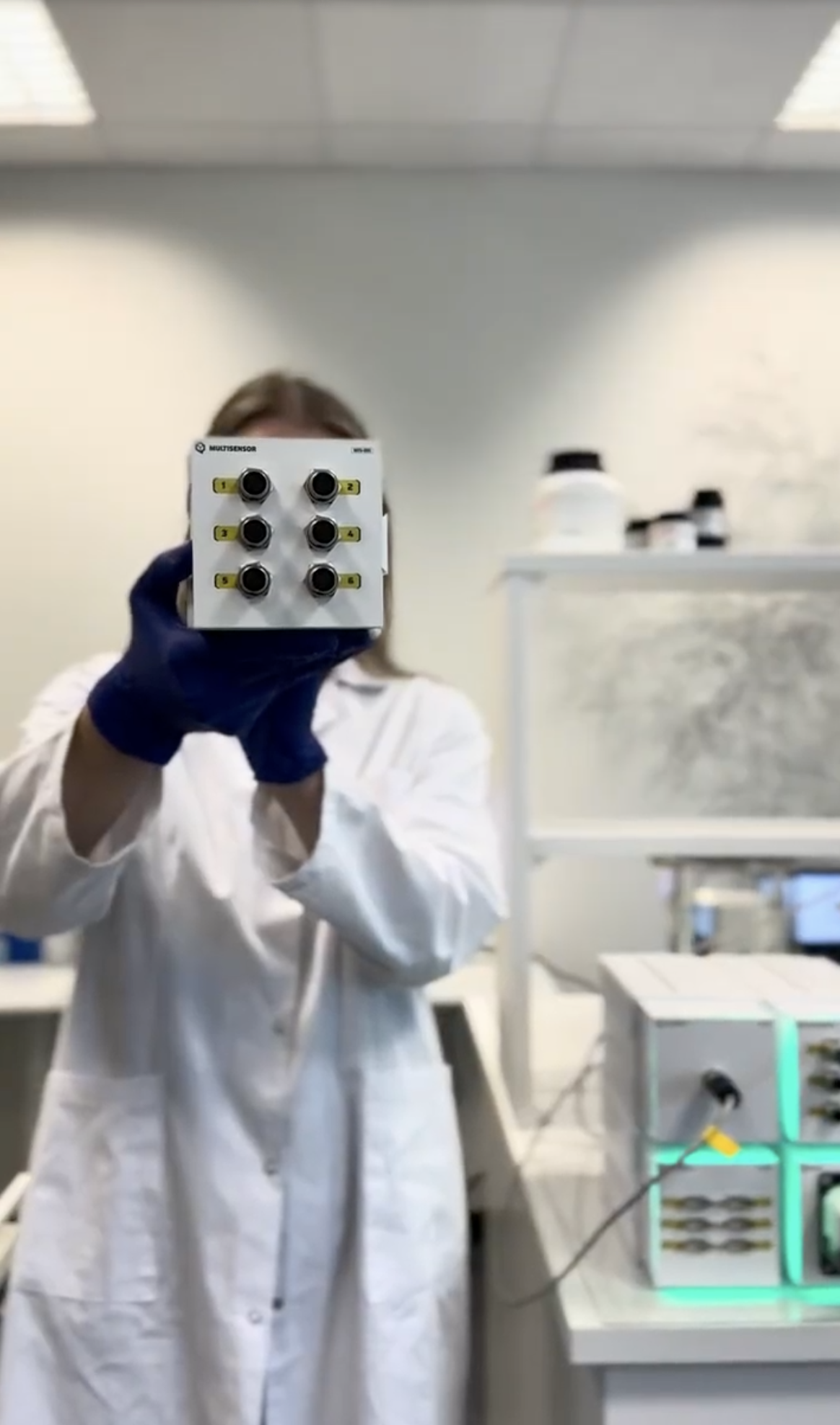
Physical layer — QB Multisensor
Replaces terminal blocks and bias resistors, providing native Power over Ethernet (PoE) for up to six sensors via a single cable.
Network layer — QB Edge
Acts as a PoE backplane with Auto-Discovery, which identifies connected modules instantly and eliminates the need for manual IP address management.
Logical layer — QB Control
A unified software environment that normalizes data from mixed-vendor fleets (such as Hamilton and Mettler-Toledo) into a single, standardized MQTT/OPC-UA model.
Comparative Analysis & Use Cases
To demonstrate the financial impact of the “Bridge” architecture, this Comparative Analysis highlights how shifting from hardware-heavy setups to a platform-centric model reduces the “Integration Tax” across various lab scenarios. By automating the most labor-intensive engineering tasks, the system delivers estimated 50–60% reduction in Total Cost of Ownership (TCO).
Summary of use cases
Note: Labor Cost Assumptions based on EU Industry Standards: Instrumentation Tech €45/h; PLC/IIoT Engineer €90–€95/h.
The Standard System
1 reservoir, 6 sensors
Context
6 digital probes (pH, Cond, etc.) into a single liquid handling unit.
Goal
Direct transmission of data to an OPC-UA/MQTT namespace with minimal hardware sprawl.
Outcome
Reduces labor costs by ~56% by shifting tasks from high-cost PLC engineers to instrumentation technicians.
| Vendor Solution | Integration Strategy | Est. Hours | Labor Cost (Estimate) | Primary Pain Point |
|---|---|---|---|---|
| QB Systems | Native PoE: Plug & Play auto-discovery + software naming. | 6 – 14 h | ~€750 | Platform governance (Scope creep). |
| Endress+Hauser (Liquiline CM448) | Transmitter-Centric: Configure 8-channel transmitter → Map to Gateway/PLC. | 12 – 26 h | ~€1,400 | “Double Configuration” (Transmitter + Gateway). |
| Mettler-Toledo (ISM + M800) | Multi-Transmitter: Wire/Config multiple M800s (4ch.+2ch.) → Map to PLC. | 14 – 30 h | ~€1,600 | Hardware sprawl (multiple boxes for 6 probes). |
| Hamilton (ARC + Converters) | RS-485/Converter: Wire bus or converters → Map Modbus registers. | 16 – 36 h | ~€1,700 | Bus instability (RS-485) & addressing errors. |
The Scaled System
2 reservoirs, 12 sensors
Context
A high-throughput setup requiring 12 total sensors across two reservoirs.
Goal
Unifying data into a single interface without doubling the engineering effort.
Outcome
Keeps integration effort nearly flat through software “Cloning,” avoiding the linear cost scaling of traditional vendors.
| Vendor Solution | Hardware Architecture | Est. Hours | Labor Cost (Estimate) | Efficiency Drag |
|---|---|---|---|---|
| QB Systems | Cloning: 2× QB Multisensors + 1 QB Edge. “Clone” Process A to Process B. | 10 – 22 h | ~€1,150 | Minimal. (Template-based scaling). |
| Endress+Hauser | Linear: 2× CM448 Transmitters. Repeat config manually. | 22 – 48 h | ~€2,420 | Duplication of work across 2 transmitters. |
| Mettler-Toledo | Fragmented: 3× M800 Transmitters. High wiring/config load. | 26 – 56 h | ~€2,830 | Integrating 3 separate hardware “islands.” |
| Hamilton | Complex: 3× Converters or RS-485 trunks. High IP/Map count. | 22 – 46 h | ~€2,300 | Managing 3 gateway endpoints & maps. |
Mixed-Vendor Environment
2 reservoirs, 12 sensors — multiple brands
Context
A system requiring a combination of brands, such as Hamilton ARC and Mettler-Toledo ISM.
Goal
Ingesting multiple proprietary protocols into a single, normalized namespace without custom driver development.
Outcome
Provides a >60% cost advantage by acting as a “Universal Receiver” instead of a custom-built integration project.
| Architecture | Strategy | Integration Effort | Labor Cost (Estimate) | Risk Profile |
|---|---|---|---|---|
| QB Systems | Native Host: Single platform ingests both protocols. | 12 – 20 h | ~€870 – €1,460 | Low (Standardized). |
| Custom Hub (Kepware/IPC) | Integration Project: Custom PC + Drivers + Mapping. | 30 – 45 h | ~€2,300 – €3,450 | High (Custom code maintenance). |
| PLC + Gateway (Anybus) | Heavy Engineering: PLC logic to bridge protocols. | 36 – 60 h | ~€2,750 – €4,500 | High (Complexity). |
Strategic Conclusion
The empirical data confirms that the Transmitter-Centric models of Endress+Hauser, Mettler, and Hamilton impose a €1,000+ per system penalty in integration labor compared to native platform architectures. They create “Hardware Islands” that require secondary bridging layers to achieve Industry 4.0 connectivity. For Lab Directors and C-Level Operations leaders, the roadmap to efficiency is clear:
Roadmap to efficiency:
Stop wiring
Adopt PoE-based architectures to eliminate RS-485 instability inherent in Hamilton setups.
Unify
Use a single multisensor island to ingest mixed fleets, saving €1,500+ per system vs. custom gateways needed for Endress+Hauser or Mettler mixed setups.
Dynamic assignment
Move to software-defined P&IDs (QB Pattern B) to enable seamless sensor sharing between reservoirs.
Final ROI
Implementing the QB Systems architecture transforms connectivity from a variable engineering project into a fixed, low-cost assembly task, delivering a verified 50–60% reduction in TCO.
Q&A
This Q&A explores how QB Systems replaces traditional, engineering-heavy sensor setups with a platform-centric model to accelerate facility startup and reduce operational overhead.
How does the QB architecture de-risk digital sensor integration compared to traditional RS-485 or Modbus setups?
Traditional sensor networks often suffer from “Engineering Debt” — hours spent on manual wiring and register mapping that introduce points of failure. QB Systems replaces this with a native Plug & Play stack.
- Eliminates physical complexity: Replaces unstable RS-485 trunks and manual termination with standard Power over Ethernet (PoE). A single cable handles both power and data.
- Automated data modeling: Removes the “Gateway Tax.” Instead of manually mapping raw Modbus registers to PLC tags, the system auto-discovers sensors and populates Process Values (PV), units, and health metrics instantly.
- Operational impact: Shifts the workflow from “engineering a bus” to “naming a process,” eliminating 20–50 hours of integration risk per deployment.
How is multi-vessel scalability and mixed-vendor flexibility managed without high reconfiguration costs?
The system decouples physical connectivity from logical assignment, allowing for a “Shared Resource” model that traditional transmitters cannot match.
- Software-Defined mapping: Unlike fixed-channel transmitters (where Slot 1 must be Vessel A), any sensor in a QB Multisensor can be dynamically assigned to any vessel via software dropdowns.
- Vendor agnostic: Acts as a “universal receiver” for Hamilton ARC and Mettler-Toledo ISM, normalizing data into a unified model. You are no longer locked into a single-vendor “walled garden.”
- Dynamic P&ID views: When a sensor is swapped or moved, the P&ID and SCADA tags update automatically. This eliminates the need for PLC reprogramming or physical rewiring during batch changeovers.
What is the impact on specialized labor requirements and total cost of ownership (TCO)?
QB Systems automates the low-level technical tasks that traditionally require high-cost engineering specialists.
- Roles eliminated: The need for dedicated RS-485 Bus Engineers, Protocol/Gateway Specialists, and PLC Mapping Engineers is removed.
- Labor shift: Integration moves from expensive senior engineers (€90+/h) to standard Instrumentation Technicians (€45/h) who simply perform physical installs & System/Process configuration in GUI.
- Direct savings: Integration costs are reduced from roughly €2,000 per vessel to €750, representing a ~60% reduction in commissioning overhead.
| Specialist Role | Traditional Setup | QB Systems |
|---|---|---|
| Bus Engineer | Required for noise/termination | Automated (PoE) |
| PLC Programmer | Required for tag mapping | Automated (Auto-discovery) |
| Field Service | High commissioning fees | Self-Service (or Remote Support) |
How does the physical and software footprint differ from component-centric competitors?
The QB Systems platform-centric approach significantly reduces hardware clutter and software configuration complexity.
- Physical footprint: Consolidates up to 6 probes into one compact Multisensor block. This replaces multiple bulky transmitters (e.g., Mettler M800 or E+H CM448) and saves significant cabinet space.
- Native IIoT connectivity: While competitors require external bridges (Kepware/Anybus) to reach the cloud, the QB Edge features native MQTT/OPC-UA output.
- Diagnostic transparency: Traditionally, sensor health data is “trapped” in the probe or transmitter. QB Systems exposes full calibration health and load cycles to the control layer by default, enabling true predictive maintenance.
Methodology & Disclaimers
1. Nature of Analysis — This whitepaper presents a subjective, assumptions-based analysis of distinct automation architectures. The comparisons regarding integration effort, time, and cost are theoretical models derived from standard industrial engineering workflows. These models serve to illustrate the structural differences between Platform-Centric (PoE/Multisensor) and Component-Centric (Transmitter/Gateway) architectures. They do not represent a guarantee of performance or cost for any specific project.
2. Assumptions & Variables — All financial estimates and labor-hour calculations are based on the following assumptions, which may differ from actual project conditions:
- Labor Rates: Calculations utilize representative European industrial contracting rates (e.g., Instrumentation Technician at €45/h; PLC/IIoT Engineer at €90–€95/h). Regional labor markets, internal burden rates, and specific vendor service contracts will cause these figures to vary.
- Scope of Integration: “Integration Effort” is defined here as the end-to-end process from physical sensor mounting to the successful transmission of data (PV + Status) to an MQTT/OPC-UA namespace. It excludes mechanical fabrication, GMP validation (IQ/OQ), and deep custom application development.
- Personnel Expertise: Estimates assume a standard proficiency level for technical staff. Highly specialized vendor experts or facilities with pre-existing, reusable code libraries may achieve faster integration times than the averages presented here.
3. Third-Party Trademarks & Brands — References to specific third-party products, including but not limited to Hamilton ARC, Mettler-Toledo ISM / M800, and Endress+Hauser Liquiline / Memosens, are for nominative and comparative purposes only. (a) All trademarks remain the property of their respective owners. (b) Mention of these brands does not imply affiliation, endorsement, or sponsorship between QB Systems and the trademark holders. (c) Product capabilities described herein are based on publicly available specifications and standard integration patterns (e.g., RS-485 Modbus RTU usage, Transmitter channel counts) known at the time of writing. Proprietary updates or custom vendor solutions may alter these architectural requirements.
4. No Disparagement Intended — This paper highlights differences in system architecture (e.g., the necessity of gateways, wiring topologies, and software bridges) rather than the quality of measurement technology. It is acknowledged that referenced third-party vendors produce high-quality, industry-standard metrology equipment. The “frictions” described in this paper are attributed to the integration methodology required to bridge legacy hardware designs with modern IIoT requirements, not defects in the sensors or solutions themselves.
5. Limitation of Liability — The content of this whitepaper is for informational purposes only. It should not be interpreted as professional engineering or financial advice. Readers should conduct their own due diligence and cost verification tailored to their specific facility requirements before making procurement decisions.