Application · Multisensor
QB Multisensor
Software-defined, multi-vendor sensing for liquid processes — standalone or as an add-on to any bioreactor, CIP skid or QC workflow.
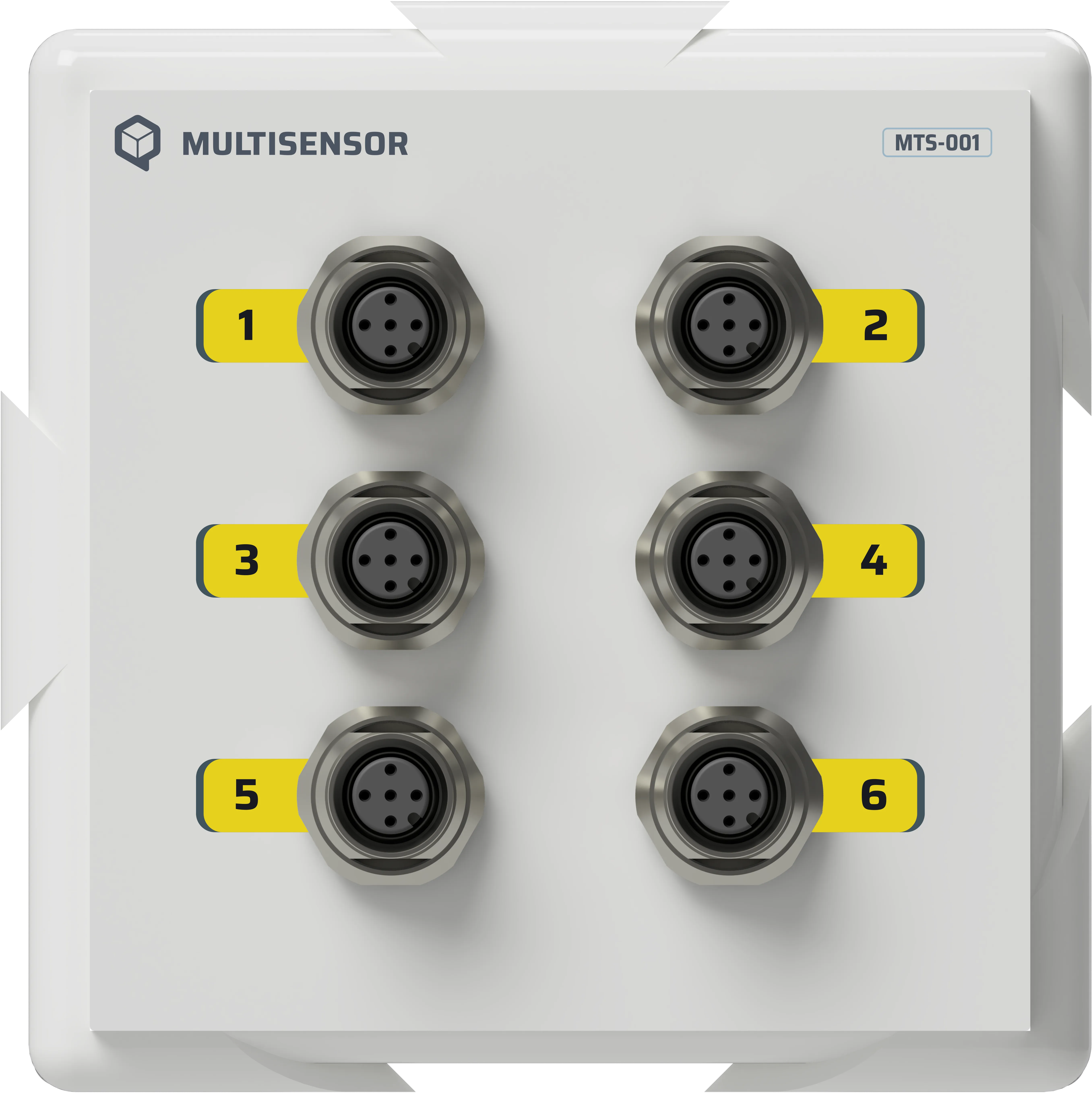
The QB Multisensor is a modular platform for inline monitoring of process parameters from digital sensors. It reads probes from multiple vendors through a single solution and — because it is software-defined — every physical port is decoupled from process configuration and represented as a data object that can be configured, assigned and reassigned entirely in QB Control.
That decoupling is what makes the platform flexible. One QB Multisensor can serve several probes to one system or to several at once — a bioreactor, a CIP skid, a QC bench — and multiple units can be pooled. Reassigning which probe belongs to which process is done in software, not by rewiring. Probes connect plug-and-play, and calibration can run inside QB Control's Calibration module.
Deploy it as a standalone monitoring system, bolt it onto a bioreactor or autosampler from QB Systems or any other vendor, or wire it into your LIMS/ELN stack for QC-lab workflows. Probe investments stay portable, integrations stay simple, and new measurements go live in minutes or hours — not days. No annual software license fees.
The sensor integration problem
Where multi-parameter monitoring loses weeks.
The sensor ecosystem is fragmented — every vendor brings its own connectors, transmitters, calibration routines and data formats. The result is a patchwork that resists change.
| The problem | What the QB Multisensor does |
|---|---|
| Every vendor is a separate hardware island | Reads Hamilton, Mettler-Toledo, QB and other digital probes through one platform |
| Integrating a handful of sensors takes days of wiring, addressing and bridging | Plug-and-play PoE connectivity with auto-discovery — new probes online in minutes to hours |
| Reassigning a probe to another process means physical rework | Ports are data objects; reassignment happens in software |
| Proprietary transmitters and buses create vendor lock-in | Open, mixed-vendor probe support keeps your sensor library an asset |
| Calibration typically tied to external vendor software | QB Control's Calibration module can also calibrate natively — depending on the probe and method (vendor software still recommended) |
| Feeding data to control systems needs custom middleware | Native OPC-UA, MQTT and Modbus TCP; direct LIMS/ELN integration |
Advantages
Six things that set it apart.
-
Software-defined sensing
Physical ports are decoupled from process configuration and represented as data objects in QB Control. Configure, assign and reassign probes to processes in software — the wiring never has to change.
-
Mix probes from any vendor
Connect Hamilton ARC sensors, Mettler-Toledo probes, the QB foam sensor and analog PT100/PT1000 sensors through a QB converter — all on one platform, at the same time.
-
Plug-and-play connectivity
Probes connect over Power-over-Ethernet with auto-discovery. Connect a sensor and QB Control detects it — no firmware flashing, no bus addressing, no termination-resistor troubleshooting.
-
Scale and reassign in software
One Multisensor can serve many probes to one or many systems; many can be pooled across systems. Parallel processing is supported, and every assignment is a software change made in minutes.
-
Integrated calibration and PAT
Calibration is built into QB Control (vendor software recommended; native calibration depending on probe and method). Real-time OUR, CER, RQ and growth rate run natively on the platform.
-
Open protocols, lower OPEX
Native OPC-UA, MQTT and Modbus TCP, plus API access, integrate with control software, MES, LIMS and ELN. Mixing vendors and reassigning probes in software cut operating costs against transmitter-based alternatives.
Where it stands apart
- Mixed-vendor probes on one platform
- Native Power-over-Ethernet with auto-discovery
- Six sensors in a single module
- Software-defined port assignment — reassign in software, not wiring
- Native OPC-UA + MQTT, perpetual license
QB Systems does not compete on the probes themselves — it works with the probes you already trust and changes how they are deployed.
Ways to deploy
Three ways to deploy.
The right one depends on what you already own and how you want the data to flow.
- 01
Standalone monitoring system
A self-contained sensing platform placed next to equipment you already run — a third-party bioreactor, a CIP skid, or a QC bench. QB Edge powers and connects the probes; QB Control provides configuration, visualization, calibration, alarms and logging. Nothing on the existing equipment has to change.
- Ideal beside a bioreactor, CIP skid or QC bench
- 02
Add-on to a QB Systems system
On a QB Systems bioreactor or autosampler, the Multisensor is a native extension. Probes join the same QB Control instance that already runs the process, so monitoring, control loops and calibration live in one interface with one audit trail — no bridging of any kind.
- One interface, one audit trail across process and sensing
- 03
Add-on to a third-party system
Attach to equipment from any vendor. Integrate over OPC-UA where the controller supports it — QB Control can expose the measured values back to your control software — or run independently under QB Control where it cannot.
- OPC-UA: new measurements exposed back to your host controller
- Independent: monitors and logs in parallel, host untouched
QC-lab & data-stack integration: beyond process control, the Multisensor integrates with LIMS and ELN through standard protocols (OPC-UA, API), enabling QC-lab workflows with audit trails, logs and client-defined measurement procedures.
In short: standalone beside existing equipment; a native add-on on QB Systems systems; for any other vendor, integrated over OPC-UA — with process values exposed back to the host — where the controller allows it, or fully independent under QB Control where it does not.
System architecture
Software-defined ports, one set of hardware.
Core modules
| Module | Role |
|---|---|
| QB Multisensor (MTS-001) | Multi-parameter acquisition module. Up to 6 sensor channels, native PoE power, auto-discovery, compact enclosure (310 × 115 × 115 mm, 2.0 kg, IP40/CE). |
| QB Edge (EDG-001) | PoE gateway and control hub. 7 PoE ports (power + data per sensor), 48 V / 220 W supply, auto-discovery, native OPC-UA / Modbus TCP, MQTT bridge, local logging, Ethernet uplink to QB Control. |
| QB Control | Software for acquisition, visualization, alarms, calibration, recipes and reporting. Live trends, P&ID builder with sensor overlays, OPC-UA server, MQTT publisher, Modbus gateway, data export. Perpetual license. |
Optional actuator modules (closed-loop control)
| Module | Role |
|---|---|
| QB Pump | Peristaltic pump controller for acid/base or feed addition (3-roller and 4-roller variants). |
| QB Gas Flow | Mass-flow-controller interface for O₂/CO₂ addition and aeration. |
| QB Thermo | PID temperature-control module for heating/cooling jackets. |
| QB Pressure Sensor | Vessel headspace / inline pressure monitoring. |
Software-defined port model
Every physical sensor port is abstracted into a data object in QB Control. Assigning a probe to a process — or reassigning it, such as switching a vessel from fermentation to cell culture — is a configuration change, not a wiring change. This is what lets one Multisensor serve several systems, many units be pooled, and probes move between processes in software.
Supported probes & calibration
Invest in probes, not ecosystems.
| Vendor / type | Parameters |
|---|---|
| Hamilton (ARC) | Dissolved oxygen (VisiFerm), pH (EasyFerm), conductivity (Conducell), cell density (Incyte/Dencytee), CO₂ (CO₂NTROL), ORP/redox, capacitance |
| Mettler-Toledo (InPro / ISM) | Dissolved oxygen (amperometric + optical), pH/ORP, CO₂, conductivity |
| Levitronix / Sonotec | Inline flow meters — Levitronix mag-lev (ranges to 160 L/min) and Sonotec ultrasonic |
| QB Systems | Foam sensor (proprietary, patent pending) |
| Analog temperature | PT100 / PT1000 via QB Systems converter |
Calibration is integrated into QB Control's Calibration module. The probe vendor's software is recommended, but the platform can also perform calibration itself — depending on the probe and the calibration method. Probes connect plug-and-play with auto-discovery.
Control loops & PAT
Close the loop, right in QB Control.
Paired with QB actuator modules, the Multisensor closes control loops directly:
-
Dissolved oxygen
DO probe drives QB Gas Flow (aeration / O₂) to hold setpoint.
-
pH
pH probe drives QB Pump (acid/base) and, optionally, QB Gas Flow (CO₂).
-
CO₂
CO₂ probe drives QB Gas Flow sparging.
-
Temperature
PT100 drives QB Thermo heating/cooling.
Native process-analytical calculations run on the platform without an external engine — oxygen uptake rate (OUR), carbon evolution rate (CER), respiratory quotient (RQ) and specific growth rate (μ) — streamed live to dashboards and available over OPC-UA and MQTT.
Technical specifications
At a glance.
| Sensor channels | Up to 6 per QB Multisensor module; pool multiple modules for more |
| Supported probes | Hamilton (ARC), Mettler-Toledo, Levitronix and Sonotec flow meters, QB foam sensor, PT100/PT1000 via QB converter |
| Connectivity | Power-over-Ethernet (48 V DC), RJ45, auto-discovery, plug-and-play |
| Communication | Native OPC-UA, MQTT, Modbus TCP; REST API |
| Data-stack integration | LIMS / ELN / MES via OPC-UA and API |
| Calibration | Integrated in QB Control (vendor software recommended; native calibration depending on probe and method) |
| PAT analytics | OUR, CER, RQ, growth rate (μ) — calculated natively |
| Control software | QB Control (real-time trends, P&ID builder, alarms, recipes, export) |
| Module enclosure | 310 × 115 × 115 mm, 2.0 kg, IP40, CE |
| Power | 48 V DC PoE; 12 W idle / 35 W active |
| Operating conditions | 4–40 °C, 15–85 % RH non-condensing |
| Compliance | Audit trail, logs and data integrity via QB Control; QC workflows via LIMS/ELN |
| Licensing | Perpetual QB Control license — no annual software fees |
Note on electronic signatures: QB Control provides audit trails, logging and data integrity. Electronic signatures are on our roadmap and coming soon; until then, e-signature workflows — for example in regulated QC — are handled through the customer's LIMS or quality management system.
Applications
One platform, many jobs.
-
Revamp control on legacy bioreactors
Bring pH and temperature monitoring — or full pH control — to a fleet of legacy vessels (e.g. six vessels, each with pH and temperature probes) without replacing the existing controllers.
-
Add a parameter to an existing process
Add temperature sensing to a chemical-synthesis reactor, or a conductivity probe to a CIP skid so the sequence can be confirmed from live conductance readings.
-
Foam detection as an add-on
Extend an existing bioreactor with QB foam detection, controlled from QB Control or handed back to the existing control software over OPC-UA.
-
Mixed-vendor, single process
Run Hamilton pH and DO probes alongside a Mettler-Toledo CO₂ probe on the same process, through one platform.
-
Dynamic probe reassignment
Switch a bioreactor between fermentation and cell culture by reassigning pH, DO, temperature, CO₂ and redox probes in software — no re-cabling between campaigns.
-
QC-lab & multi-vessel monitoring
Feed a LIMS/ELN stack with audit-trailed measurements for QC workflows, or run one QB Control instance across parallel bioreactors for cross-vessel comparison.
Frequently asked questions
What does the QB Multisensor actually do?
It provides inline monitoring of liquid-process parameters from digital sensors, reading probes from multiple vendors through one software-defined platform. Ports are represented as data objects in QB Control, so probes can be configured, assigned and reassigned to processes without rewiring.
Which probes and sensors are supported?
Digital probes including Hamilton ARC sensors (pH, DO, conductivity, capacitance, redox and more) and Mettler-Toledo probes, Levitronix and Sonotec flow meters, the QB foam sensor (proprietary, patent pending), and analog PT100/PT1000 temperature sensors through a QB converter.
Can I mix probes from different vendors on the same process?
Yes. That is a core purpose of the platform — for example Hamilton pH and DO probes together with a Mettler-Toledo CO₂ probe on one process, with no complex integration.
How does it connect to my existing control system?
As a standalone system beside your equipment, or as an add-on. If your controller supports OPC-UA, the Multisensor integrates with it and QB Control can expose the measured values back to your control software. If it does not, the Multisensor runs independently. LIMS/ELN/MES integration is available over OPC-UA and API.
Do I need separate calibration software?
The probe vendor's calibration software is recommended, but not strictly necessary — QB Control's Calibration module can perform calibration itself, depending on the probe and the calibration method.
How many sensors can one unit handle, and does it scale?
Each QB Multisensor module supports up to 6 sensor channels. The platform scales by pooling multiple modules and assigning their probes to one or many systems in software, with parallel processing supported.
Does it support 21 CFR Part 11 / electronic signatures?
QB Control provides audit trails, logging and data integrity. Electronic signatures are on our roadmap and coming soon; until then, they're handled through the customer's LIMS or quality management system for regulated QC workflows.
See the QB Multisensor with your own probes.
Request a live demonstration, discuss a standalone or add-on deployment, or get a configuration matched to your systems and sensor library.
Contact us
Thank you! Your message has been sent — we’ll be in touch shortly.
Sorry, something went wrong sending your message. Please email us directly at [email protected].