Application
Benchtop bioreactor system with open control software
Modular benchtop bioreactors from 500 mL to 10 L glass, built from plug-and-play QB Modules and run by QB Control, the bioreactor software you also use for the rest of your lab.
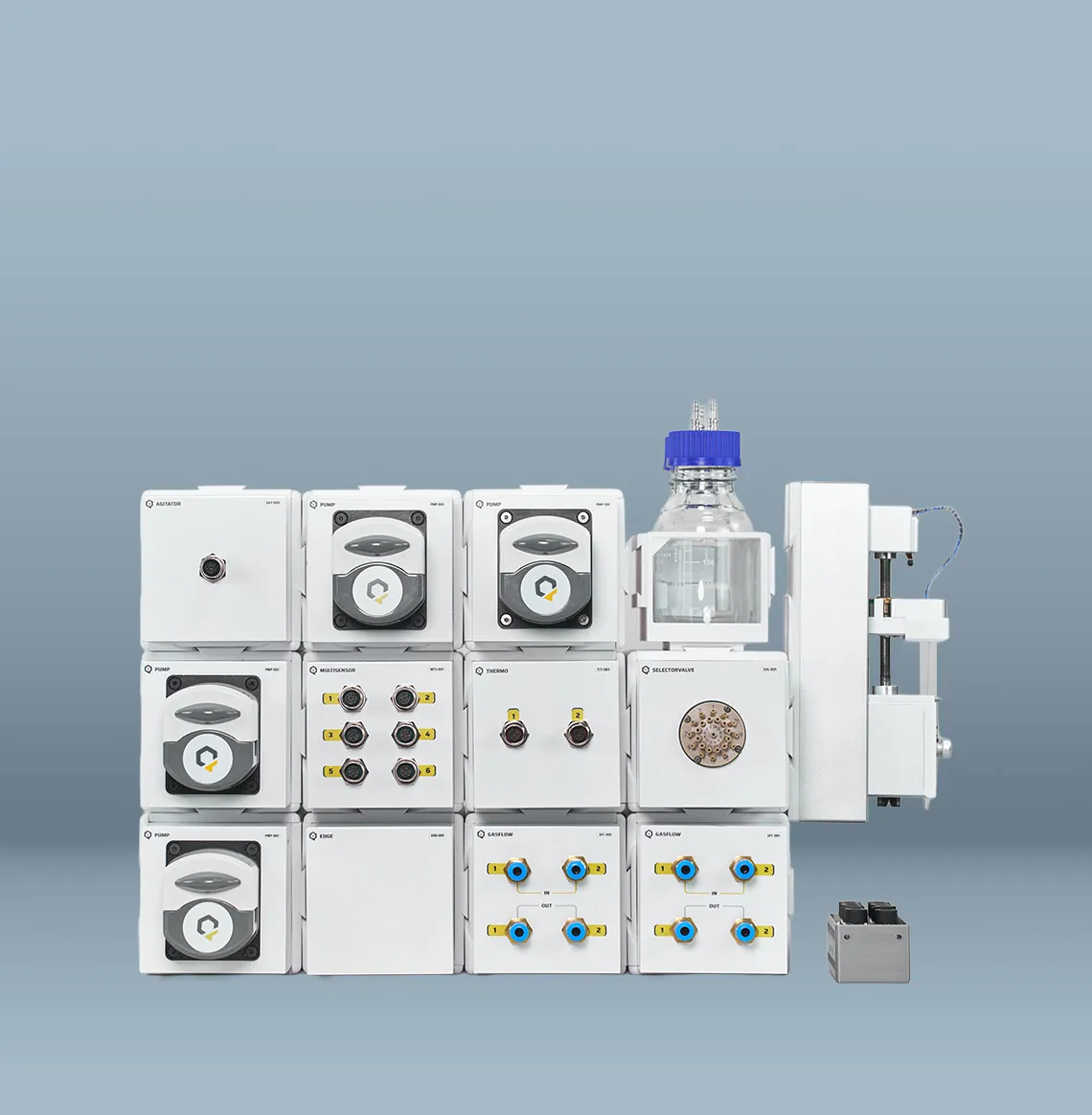
The QB Bioreactor is a modular benchtop bioreactor system for bioprocess R&D. Glass vessels from 500 mL to 10 L sit on standard QB Modules for gas, temperature, agitation, pumping and sensing, and QB Control runs the whole system from a browser: recipes, live P&ID, alarms, graphs and audit trail.
Because the system is built from modules, you start with what your process needs and add feeding, foam control, dosing, sampling or pressure control later, without replacing the bioreactor. The same QB Control software also runs equipment you already own, so one bioreactor control system can cover a mixed lab.
It is used for microbial and mammalian cell culture, enzyme, algae and food production, and yeast, bacteria and fungi fermentation.
Ways to deploy
Meet your hardware where it is.
New, revamped, retrofitted or custom — pick the path that fits your existing equipment and requirements.
- 01
New — QB Systems bioreactor
A complete modular setup: QB Modules and QB Control with vessel, headplate and accessories, engineered and built by QB Systems — and available as an OEM product.
- Scales: 500 ml glass (150–400 ml working volume), 1–10 L glass vessels, and stainless-steel vessels of any size on demand via partner companies.
- Single-wall or jacketed glass vessels, matched to your temperature-control strategy.
- Reconfigure at any time — feeding, foam management, multi-sensor, temperature control, dosing, sampling, pressure — just by adding modules and services.
- 02
Revamped — upgrade an existing bioreactor
Keep your vessel and gain QB capabilities. Either run QB Modules + QB Control through a QB Edge on your existing vessel (after a compatibility check on probes, agitator and accessories), or add specific QB solutions to a bioreactor you already operate.
- Feeding — basic (pump) or gravimetric (pump, scale, QB Multiscale)
- Foam management — QB Multisensor, QB Edge, pump and foam sensor
- Sampling — basic (QB Edge, selector valve, syringe pump) or with a cooling chamber (adds chiller, multisensor, temperature sensor)
- Precise dosing — QB Edge, syringe and peristaltic pumps, optionally with scales
- Multisensor, thermo (chiller) and pressure-control add-ons — or any mix of the above
- Integration: fold the add-on into your controller over OPC-UA, or run it independently under QB Control.
- 03
Retrofitted — modernize a PLC bioreactor
For a second-hand or vendor-locked bioreactor (e.g. Sartorius): QB Systems modifies the PLC and electronics — optionally swapping analog probes for digital — and installs QB Control to fully replace the vendor's control software.
- Requires a PLC-based system that can be replaced
- Requires existing documentation — electrical, functional and connectivity/signal specs
- Optional analog-to-digital probe upgrade
- 04
Custom SKID — engineered to your URS
For unique requirements, QB Systems works with SKID-builder partners — or directly with you — to deliver a custom bioreactor. Typically a stainless-steel, PLC-based system with the QB Control software-defined layer on top, and available as an OEM product.
- Built to your URS and specific, often unique, requirements
- Usually stainless steel with PLC-based control plus the QB Control layer
- Delivered together with SKID-builder partners
Build your custom setup
What's included
-
QB Modules
1 Edge Control Unit 1 Multisensor 2 Gasflow 1 Chiller / Heater 6 Pumps 1 Agitator
-
QB Control
System Management (Multiple system & multi process) Dynamic P&ID Recipe Management Alarms & Notifications Advanced Graphs Audit Trail Inventory Management Remote Access + many more
-
QB Accessories
Glass Vessel (jacketed) pH Sensor Temperature PT100 Sensor Dissolved Oxygen Sensor CO2 Sensor Redox/ORP Sensor Conductivity Sensor Foam Sensor Air Compressor
Key benefits
-
Fully customizable system
that scales with your research or production goals.
-
High-precision control and automation
improves reproducibility and process efficiency
-
Integrated data management
facilitates in-depth process insight and optimization
Areas of application
- Cell culture
- Enzyme production
- Algae production
- Food production
- Yeast, bacteria, and fungi fermentation
Specifications
Technical specifications
- Vessels
- 500 mL glass (150–400 mL working volume) and 1–10 L glass; stainless-steel vessels of any size through partner companies
- Vessel type
- Single-wall or jacketed glass, matched to your temperature-control strategy
- Typical modules per bioreactor
- 1 QB Edge control unit, 1 QB Multisensor, 2 gas flow modules, 1 chiller/heater, 6 pumps, 1 agitator
- Sensors
- pH, PT100 temperature, dissolved oxygen, CO2, redox/ORP, conductivity and foam
- Add-ons
- Gravimetric feeding, foam management, precise dosing, automated sampling with cooled storage, pressure control
- Control software
- QB Control, in Basic, Advanced and Pro licences: recipes, dynamic P&ID, alarms and notifications, advanced graphs, audit trail, inventory, remote access
- Connectivity
- OPC-UA, Modbus TCP, MQTT and REST, for third-party devices, LIMS, MES and ERP
- Compliance tools
- Audit trail, PDF reports, role-based access and ISA-18.2 alarm management; electronic signatures are in development
- Indicative price
- $60–85K for a four-bioreactor lab setup with QB Control; the final price depends on configuration
Learn more
Software, add-ons and projects
- QB Control: bioreactor control software →
- QB AutoSampler: automated bioreactor sampling →
- Bioreactor control system retrofit →
- Case study: a mammalian-cell bioreactor delivered in 30 days →
- Case study: long-term cell cultures in perfusion mode →
- Case study: controlling and monitoring an algae process →
- Scale and architecture model: from lab to pilot →
- QB Control compared with other bioprocess control platforms →
Got questions? We have answers
What is a benchtop bioreactor?
A benchtop bioreactor is a small bioreactor, typically from a few hundred millilitres to about 10 litres, that stands on a lab bench. It holds temperature, pH, dissolved oxygen, feeding and mixing under control so cells or microbes grow reproducibly, and it is used for process development before scale-up.
Which vessel sizes are available?
500 mL glass vessels with 150–400 mL working volume, and glass vessels from 1 to 10 L, single-wall or jacketed. Stainless-steel vessels of any size are available through partner companies.
Can I keep my existing bioreactors?
Yes. You can run QB Modules and QB Control on an existing vessel after a compatibility check, add a single QB solution such as feeding or sampling to a bioreactor you already operate, or retrofit a PLC-based bioreactor so QB Control replaces the vendor's control software.
What bioreactor software controls the system?
QB Control, a browser-based bioreactor control software. It runs QB Modules and third-party equipment over OPC-UA and Modbus, with no-code recipes, a live P&ID, alarms, graphs and an audit trail. It is licensed as Basic, Advanced or Pro.
Is it suitable for mammalian cell culture and microbial fermentation?
Yes. QB bioreactors are used for mammalian cell culture, including long-term perfusion, and for microbial, yeast, fungi and algae cultivation. The module set and vessel are chosen per process.
How much does a QB bioreactor system cost?
As an indication, a four-bioreactor lab setup with QB Control costs $60–85K. The final price depends on vessels, modules and software licence, so we quote each configuration.
Can it be used in a regulated environment?
QB Control provides an audit trail, PDF reports, role-based access, versioning and ISA-18.2 alarm management. Electronic signatures are in development; until then they are handled through your LIMS or quality system. Compliance and validation remain properties of your validated process.
Interested in the QB Bioreactor system?
Schedule a demo. See how to accelerate and automate your bioprocesses.
Contact us
Thank you! Your message has been sent — we’ll be in touch shortly.
Sorry, something went wrong sending your message. Please email us directly at [email protected].