Article
Building Hardware at Software Speed: AI-Assisted Hardware Engineering of Bioprocess Modules
By Łukasz Paciorkowski & Przemek Ernest · 22 min read
1. Executive summary
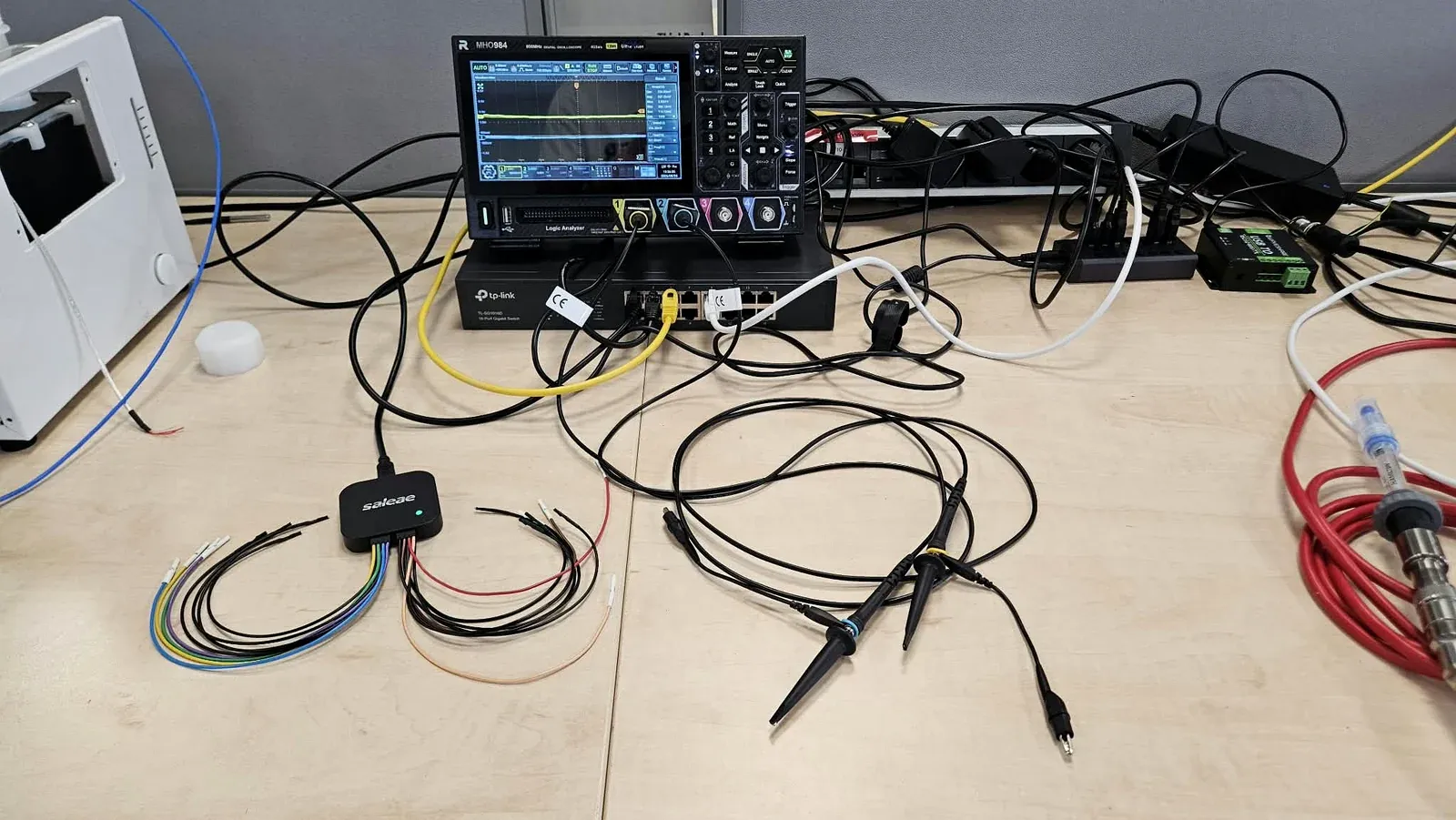
The bottleneck in bioprocess equipment is not the science. It is the time it takes to build the instrument. A genuinely new lab or bioprocess platform takes four to seven years from concept to launch, and even an incremental variant — a new sensor, a faster board, a larger single-use volume — typically needs one and a half to two and a half years. Most of that time is spent on the parts of hardware engineering that do not appear in a datasheet: laying out boards, writing and bringing up firmware, chasing communication faults, and testing the finished unit across every way it can fail.
QB Systems compresses that work with AI-assisted hardware engineering applied across the whole module lifecycle rather than one stage of it — hardware and electronics design, embedded firmware, communication debugging, and testing across the electrical, electronic, functional and fluidic domains. The point of this document is that the resulting velocity is not a slogan. It is visible in shipped results and it is defensible, because it rests on a modular, software-defined platform where every new module and every run makes the next one faster.
4 days
a custom perfusion bioreactor taken to a 12-hour verified, unattended batch (observed)
weeks → minutes
control-parameter tuning, from 4.4M exported data points analysed by AI (observed)
15–30×
fewer engineering hours than a conventional PLC build of the same rig (modeled)
For an investor or partner the question is whether “new modules in weeks” is real and hard to copy. Sections 5 and 4 answer both: the evidence is published, and the advantage compounds — it is not a one-off.
2. The state of AI in hardware engineering
AI has moved from pilot to production across the hardware lifecycle, which means QB is not betting on an unproven idea — it is applying a wave that the largest engineering-software companies have already committed to.
- Chip and board design. The electronic-design-automation leaders — Synopsys and Cadence — have shipped reinforcement-learning and agentic AI across the chip-design flow, and Cadence states its AI tools have been used in over a thousand tapeouts. One layer down, at the circuit-board level, a new generation of tools handles AI-assisted PCB design and autorouting from a specification: Cadence’s Allegro X AI, and startups such as Diode, Quilter, Flux and JITX.
- Embedded firmware. Purpose-built tools now read a component datasheet and generate register-correct driver code — Embedder and Hydron index hundreds of microcontroller platforms and ground each peripheral initialisation in the target device’s actual specification; Analog Devices’ CodeFusion Studio connects an AI assistant directly to a live debug session on real silicon.
- Physics, test and labs. AI surrogate models compress simulation from hours to seconds; AI-driven test automation and hardware-in-the-loop (HIL) rigs are maturing; AI vision inspection is a large, deployed market; and in life science, lab automation, self-driving labs and GMP bioprocess digital twins are the frontier.
Two honest caveats travel with this. Most of the published productivity figures are vendor-stated, and the “autonomy” on offer is partial — today’s systems keep an engineer in the loop for judgement and anomaly handling. QB’s own claims in this document are framed the same way: AI is an assistant that multiplies engineers, not a replacement for them.
3. Why new bioprocess hardware takes years to build
Two structural facts explain the multi-year timeline, and together they define the gap QB is built to close.
Instrument engineering is full-stack, and the stack is deep. A bioprocess module is not a board. It is a board and its power and wiring, and the firmware on it, and the communication bus that links it to everything else, and the fluid path it controls — pumps, tubing, valves, sensors in contact with liquid. A pump module only earns its place when it dispenses the right mass of a viscous feed, through tubing that changes after autoclaving, without leaking, and reports it truthfully. Every one of those layers is a separate discipline with its own failure modes, and a new module is not done until all of them pass.
The available AI tools are fragmented and electronics-centric. The market in Section 2 is real, but it is a collection of point tools — one for the schematic, another for the layout, another for firmware, another for waveform search — and almost all of it targets chips, PCBs, automotive and aerospace. Two parts of the instrument stack are left almost untouched:
So the gap is not a missing tool. It is that no one has stitched AI across the whole instrument stack — including the fluidic layer — for bioprocess hardware. That is precisely the seam QB works in.
4. QB’s approach: AI across the module lifecycle
QB applies AI at each stage of building a module. The descriptions below are method-level by design — the point is not any single tool but that the stages are connected, and that the last of them, fluidic testing, is one almost no one else automates.
4.1 Hardware and electronics design
At the design stage QB uses AI the way the tools in Section 2 intend it: to turn a requirement into a first-draft schematic and bill of materials, to read the long datasheets where the real constraints hide, and to accelerate board layout and the signal- and power-integrity checks that used to wait until the end of a design cycle. The engineer stays in control of the decision; the AI removes the hours of boilerplate and lookup around it. Because QB’s modules share a common architecture — power-over-Ethernet, a single cable carrying power and data, auto-discovery on the network — each new module starts from a proven electrical pattern rather than a blank page, which is what makes AI-assisted design reusable rather than one-off.
4.2 Embedded firmware
Firmware is where embedded engineers spend a large share of their time, most of it on driver boilerplate and bring-up rather than on anything novel. QB uses the now-viable class of datasheet-aware AI assistants to generate the register-correct scaffolding for a new sensor or actuator — the I²C, SPI, UART and Modbus initialisation that is mechanical but error-prone by hand — and to explain and review unfamiliar code during bring-up. The engineer verifies every generated line against the source datasheet and against the hardware; the gain is that a new peripheral reaches “talking” far sooner, so the scarce engineering time goes to control behaviour and edge cases, not to typing out a register map.
4.3 Communication debugging
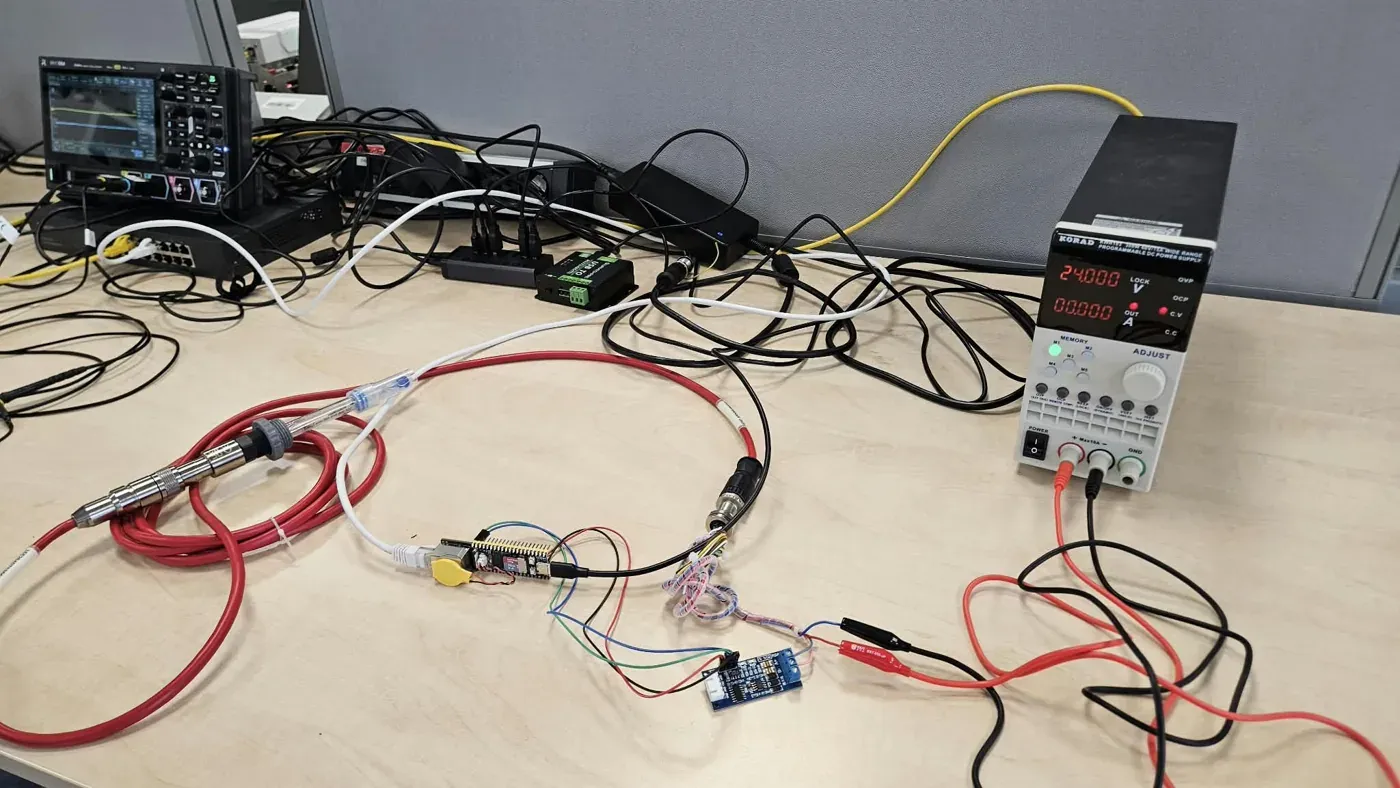
Getting modules to talk reliably — over the internal buses and over the industrial protocols QB Control speaks (Modbus TCP, OPC-UA, MQTT) — is one of the slowest, least glamorous parts of a build, and, as Section 3 noted, the part the market has left least served. QB uses AI to compress it: to set up and interpret protocol decodes quickly, to search long captures for the one anomalous exchange, and to reason about the likely cause of an intermittent fault from the traffic around it. This is assisted diagnosis, not autonomous repair — but on a problem where the industry norm is still an engineer staring at a logic-analyser trace, a faster path from symptom to cause is a real advantage.
4.4 Testing: electrical, electronic, functional, and fluidic
Testing is where QB’s approach is most distinct, because a bioprocess module has to pass in four domains, and the fourth is one the wider AI-hardware market effectively ignores.
Electrical
- Power, PoE delivery, wiring and connector integrity
- The module is safe and correctly powered before anything else runs
Electronic
- Board- and register-level behaviour
- Chips, firmware and the readings they produce are correct and repeatable
Functional
- The module does its job inside a real process
- Control loops hold, recipes execute, and the system behaves end to end under the audit trail
Fluidic
- The part almost no one automates
- Flow rate, dosing accuracy and leak integrity — the right amount of the right liquid, only where intended
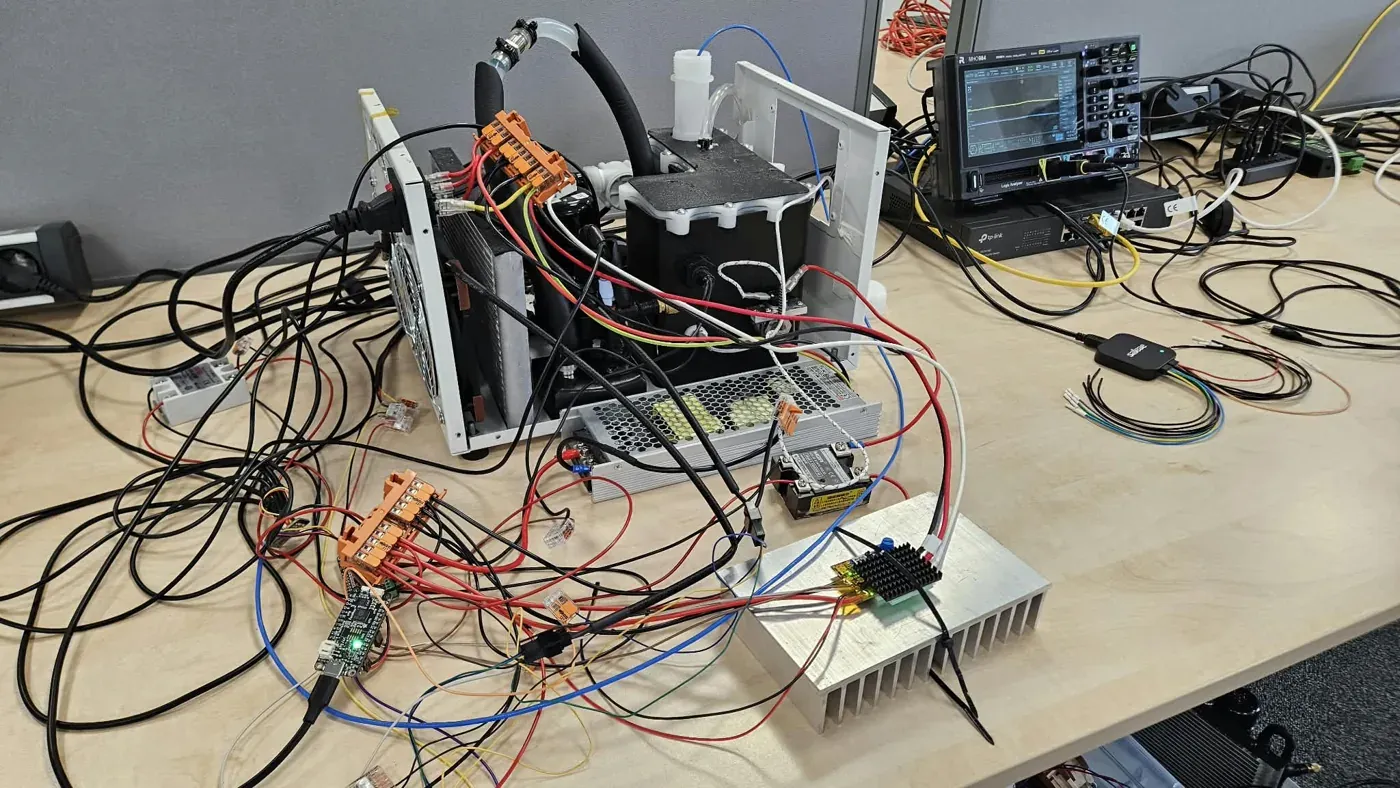
AI helps QB plan, run and interpret tests across all four. The fluidic domain is the telling one. Elsewhere in the industry, AI has only recently begun to reach liquid handling — for example, computer-vision models that watch a liquid handler to catch missing tips and wrong volumes (Applied Intelligence, 2025), and automated leak and low-volume-verification routines for diagnostic fluidic systems (Xtalks). QB’s advantage here is not a single vision model; it is that its modules already measure the fluid — a pump paired with a load cell weighs what it dispenses — so fluidic testing is grounded in physical mass, and the data to interpret it with AI is already there. Section 5 shows that in numbers.
4.5 The compounding loop: why the advantage grows
The stages above are not independent. Because QB’s platform is software-defined, every run exports richly contextualised data — each signal carried together with the recipe, the system definition, the audit trail and the operator’s actions — and that same data is what makes AI useful at the next stage and the next build. A tuning result becomes a shipped default. A new module template becomes the starting point for the module after it. A communication fault, once diagnosed, becomes a check that runs automatically thereafter. This is the part that is hard to copy: a competitor can adopt any one of the point tools in Section 2, but not the accumulated library of proven modules and the labelled data flywheel that make QB’s next module faster than its last.
4.6 One engineer orchestrating AI agents across domains
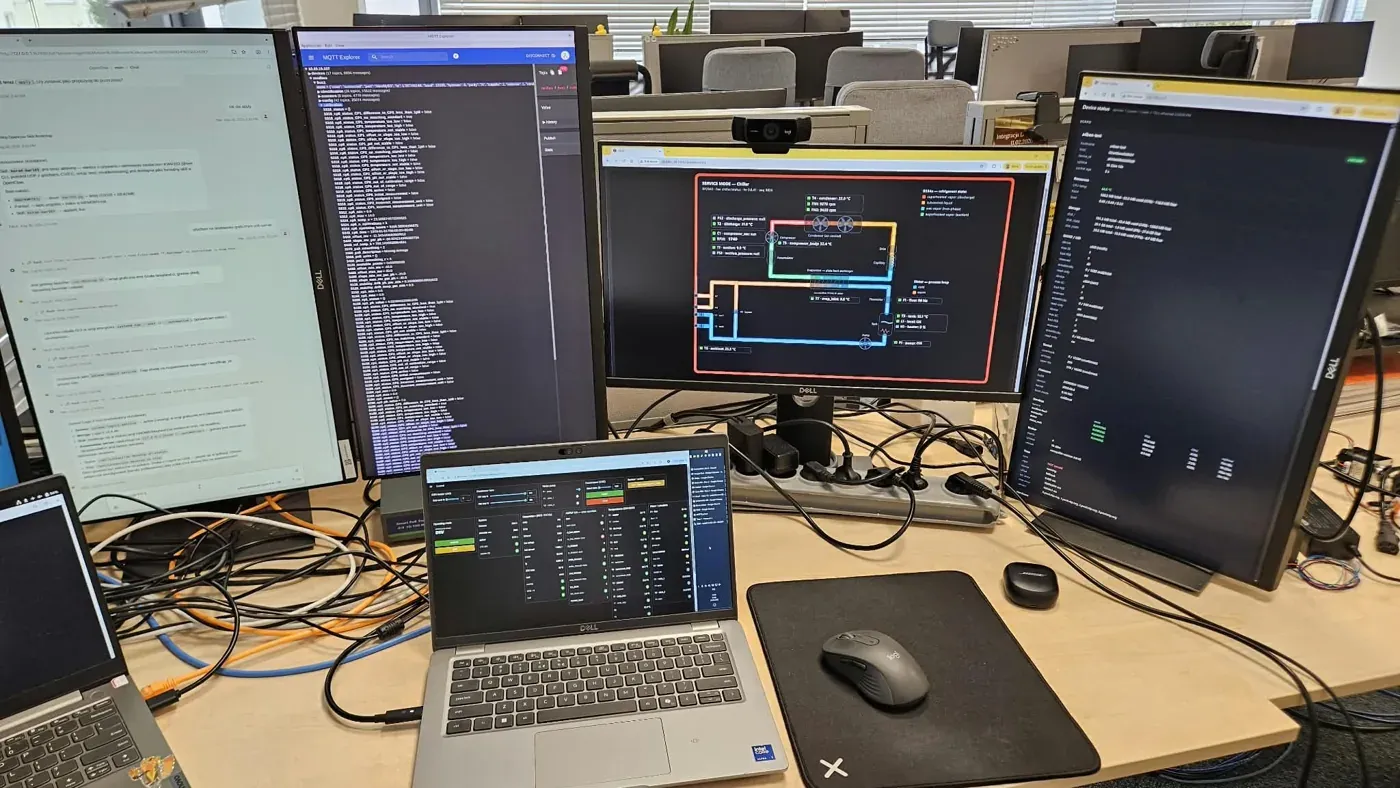
The deepest source of the speed is organisational, not technical. A conventional bioprocess-instrument build is a relay race between specialists — an electronics engineer, a firmware engineer, a controls engineer, a test engineer — and most of the elapsed time is not the work itself but the space between the work: specification hand-offs, integration meetings, waiting in another team’s queue, and the misunderstandings that only surface when two subsystems finally meet. That coordination is the hidden tax that turns months of effort into years of calendar time.
QB collapses the relay into a single lane. Because AI now does the domain-level work — drafting the schematic, generating the driver, decoding the bus, planning the test — one lead engineer can act as the orchestrator across all of it: directing agents that execute the sub-tasks in parallel, then integrating and reviewing the results against the hardware. The electrical, embedded, communication and fluidic work that used to move sequentially between four people advances at the same time, under one person who holds the whole module in their head. This is the concrete meaning of agentic leverage: the agents are the workforce; the engineer is the conductor — and does in a fraction of the time what a team, and the coordination between them, used to require.
The trade-off is honest, and for a competitor it is the hardest part to copy. This model does not work with narrow specialists. It demands lead engineers with broad technical, process and business knowledge — people who can reason across electronics, firmware, control and fluidics and the regulated process the module serves, and who can judge an AI agent’s output in every one of those domains. The tools are available to anyone; the ability to orchestrate them across the full stack, correctly, is not. That is where the advantage actually lives.
4.7 The AI models and agents behind the work
The orchestration described above runs on a concrete, deliberately mixed stack of AI models and agents. QB is model-agnostic by design: frontier models from the leading AI labs where reasoning quality decides the outcome, open-source and open-weight models where cost, latency or keeping data inside the network matter more, and purpose-built agents to carry out the multi-step engineering work.
- Anthropic Claude and Claude Code are the workhorse for the engineering itself — drafting and reviewing embedded firmware and control code, reasoning across a module’s electrical, electronic and communication subsystems, and acting as the agentic coding layer that a lead engineer directs and checks.
- OpenClaw is one of the orchestration agents that coordinates the multi-step work: sequencing sub-tasks, running tools, and handing results back to the engineer-orchestrator described in §4.6.
- Google Gemini is used for research and datasheet collection — extracting pinouts, register maps, timing diagrams and configuration detail from long component PDFs, and gathering the reference material a new module’s design and firmware start from.
- Frontier-lab and open-source models round out the stack: frontier models from the leading AI labs for the hardest reasoning, and open-source, open-weight models where they run cheaper, faster, or on-premise for sensitive or high-volume tasks. The model is chosen per task, not fixed to one vendor.
The principle mirrors the rest of the approach — the best tool for each job, with a qualified engineer accountable for every output. No model is left to design or release hardware on its own.
5. The evidence: what the approach has produced
Method matters only if it ships. Two published QB results — one on build speed, one on AI-driven tuning — show the approach working end to end.
A custom perfusion bioreactor, built and proven in four days. A one-litre custom perfusion rig went from three gas valves and no control loops to a thirteen-module perfusion process running eight closed control loops, verified over a twelve-hour batch running unattended overnight — in four days, with no control code written, no I/O rewired, and no controller firmware downloads. Media exchange balanced to 0.05% over the twelve hours. Along the way, thirty-three recipe iterations were created and twenty-nine discarded in a single day, because the cost of a failed experiment was twenty-six seconds of reactor time — at that price, measurement replaces assumption as the default engineering method, which is exactly the condition AI-assisted iteration needs.
Control-parameter tuning, from weeks to minutes. Tuning a gravimetric feed loop means finding the right controller parameters for a specific fluid, pump and back-pressure. The conventional method — run a batch, review the trends by hand, change one parameter, repeat — turns a couple of hundred parameter changes into weeks of work. QB instead exported the full batch record, 4.4 million data points, and ran it through an AI analytics pipeline that returned a validated parameter set in minutes. That set now ships as a service default — the tuning became a product feature, not a one-off.
The build-speed result, set against a conventional programmable-logic-controller build of the same rig, is what the “software speed” in the title means:
| Dimension | QB Control | Conventional PLC + SCADA build |
|---|---|---|
| Time to a 12-hour verified batch | ◆ 4 days (observed) | 3–6 months (modeled) |
| Engineering hours | ◆ 15–20 (observed) | 300–580 (modeled) |
| Control code written | ◆ None — composed, not coded | Extensive (logic + HMI) |
| Controller firmware downloads | ◆ 0 | ~40 (modeled) |
| Tuning a control loop | ◆ Minutes — AI analytics on exported data | Weeks — manual trend review |
For an investor the read-across is direct. The same properties that took this rig to a verified batch in four days — modular hardware, composition instead of code, contextualised data an AI can act on — are the properties that let QB add a new product module in weeks. The build velocity and the roadmap velocity are the same mechanism.
6. What QB does not claim
Credibility here depends on being precise about the limits.
- This is AI-assisted, not autonomous. An engineer specifies the module, reviews every AI-generated line against the datasheet and the hardware, and signs off every test. QB does not claim an AI that designs or releases hardware on its own — consistent with the wider market, where genuine autonomy remains partial.
- Measurement still governs. AI accelerates the interpretation of data; it does not remove the need to measure. The four-day rig worked because the cost of a real experiment was seconds, not because experiments were skipped.
- The modeled figures are estimates. The comparison against a conventional PLC build uses engineering estimates for the conventional side; they are illustrative, not quotes. The observed QB figures come from a documented build.
- This is separate from the product’s AI story. “AI-assisted engineering” is how QB builds. “AI-ready” is what customers get — a platform whose contextualised data their own frontier models can optimise. The two reinforce each other but should not be conflated.
7. Where this goes next
The direction of travel across both the EDA world and the lab-automation world is the same: from point tools toward connected, multi-stage “engineering assistants,” with the human moving up to judgement and approval. QB’s position on that curve is favourable, because the scarce ingredient for the next step is not a model — it is high-quality, contextualised data from real physical systems, and that is exactly what a software-defined, modular platform produces on every run. As the module library and the data flywheel grow, the cadence of new modules should shorten further. The advantage is designed to compound.
Methodology, Assumptions & Legal Disclaimer
Observed figures come from QB’s published engineering write-ups. The four-day perfusion build — thirteen modules, eight closed control loops, a twelve-hour unattended verified batch, 0.05% media-exchange balance, 15–20 engineering hours, zero controller downloads, and the recipe-iteration and reactor-time figures — is drawn from QB’s case write-up of that build. The gravimetric-tuning figures — 4.4 million exported data points, a couple of hundred parameter changes, and the reduction of tuning from weeks of manual review to minutes of AI analysis, deployed as a service default — are drawn from QB’s gravimetric-feeding report.
Modeled figures describe the conventional PLC + SCADA alternative: 300–580 engineering hours, 3–6 months of elapsed time, and roughly forty controller downloads for an equivalent rig. These are engineering estimates based on typical industry workflows for a comparable build; they are illustrative and are not benchmarks, guarantees or quotations. The “15–30× fewer engineering hours” headline is the ratio of the observed QB effort to this modeled range.
Market context (Section 2 and the fluidic and communication references in Sections 3–4) is drawn from public documentation and reporting on the named companies and from the cited research; those third-party productivity figures are generally vendor- or single-study-stated and should be read as directional.
Nothing in this document describes autonomous operation. Every AI-assisted step described keeps a qualified engineer responsible for review and sign-off.
Flexible. Innovative. Limitless.