Comparison · QB AutoSampler vs. Eppendorf Bioprocess Autosampler
QB AutoSampler vs Eppendorf Bioprocess Autosampler Comparison
Important notice. This comparison is published by A4BEE Sp. z o.o., the company behind the QB Systems brand and QB Control, and therefore is not independent. It compares products intended for the same purpose (benchtop automated sampling of bioreactors) on the basis of publicly available information as of 19 October 2026, comparing the QB AutoSampler (QB Control sampling services) with the Eppendorf Bioprocess Autosampler. It contains no prices and is not an offer. See the full Legal Notice & Disclaimer at the end of this document.
Same bench, same vessels · drag to swap the sampler
QB AutoSampler and Eppendorf Bioprocess Autosampler on a laboratory bench
Bench top 2.1 m × 0.62 m, 0.9 m high (illustrative), dotted grid every 500 mm. Lines show the overall width and depth of each set; QB shows its minimum and maximum width. Vessels are generic (Ø160 × 300 mm) and illustrative.
Dimensions and sources (W × H × D, mm)
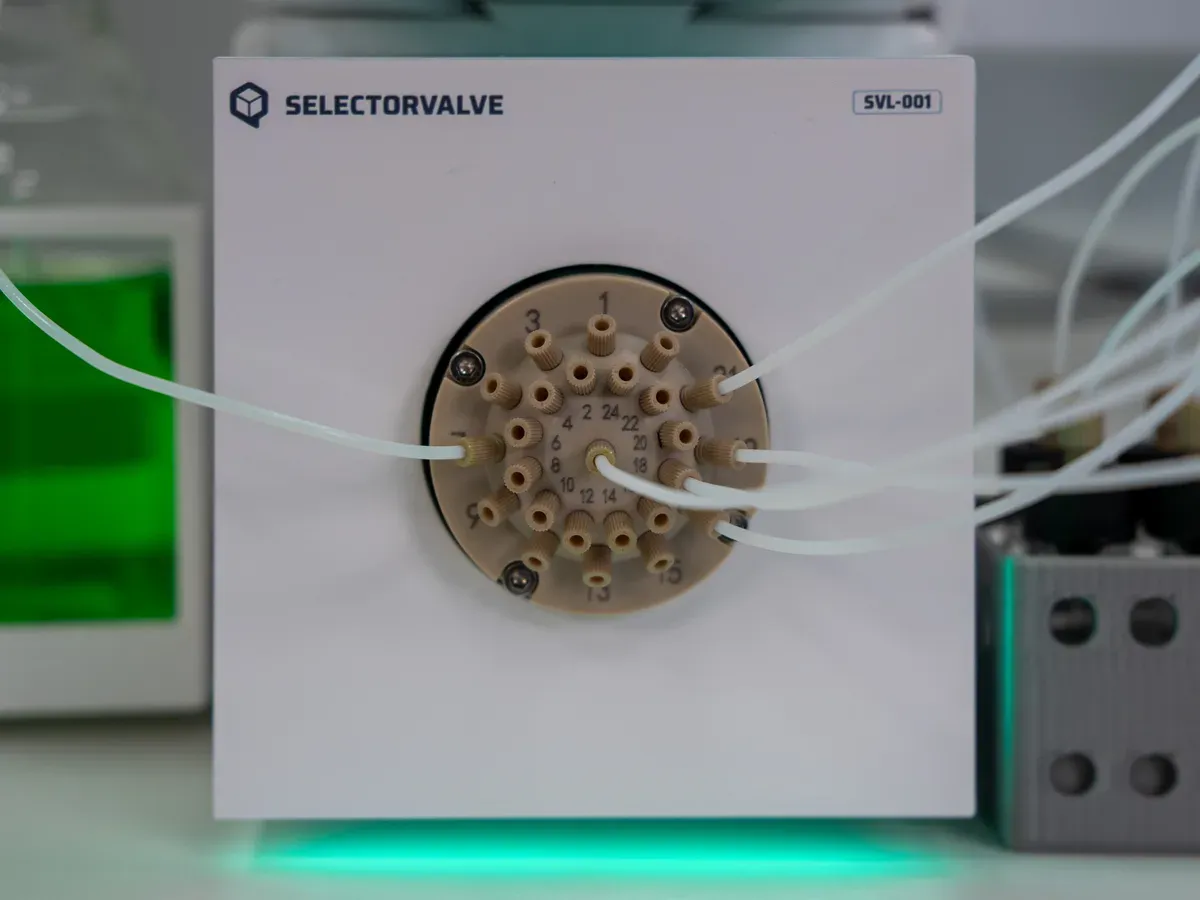
- QB Selector Valve SVL-001 115 × 115 × 320 mm datasheet lists 320 × 115 × 115; drawn with the 320 mm side as depth
- QB QB Edge EDG-001 115 × 115 × 310 mm datasheet W × H × D
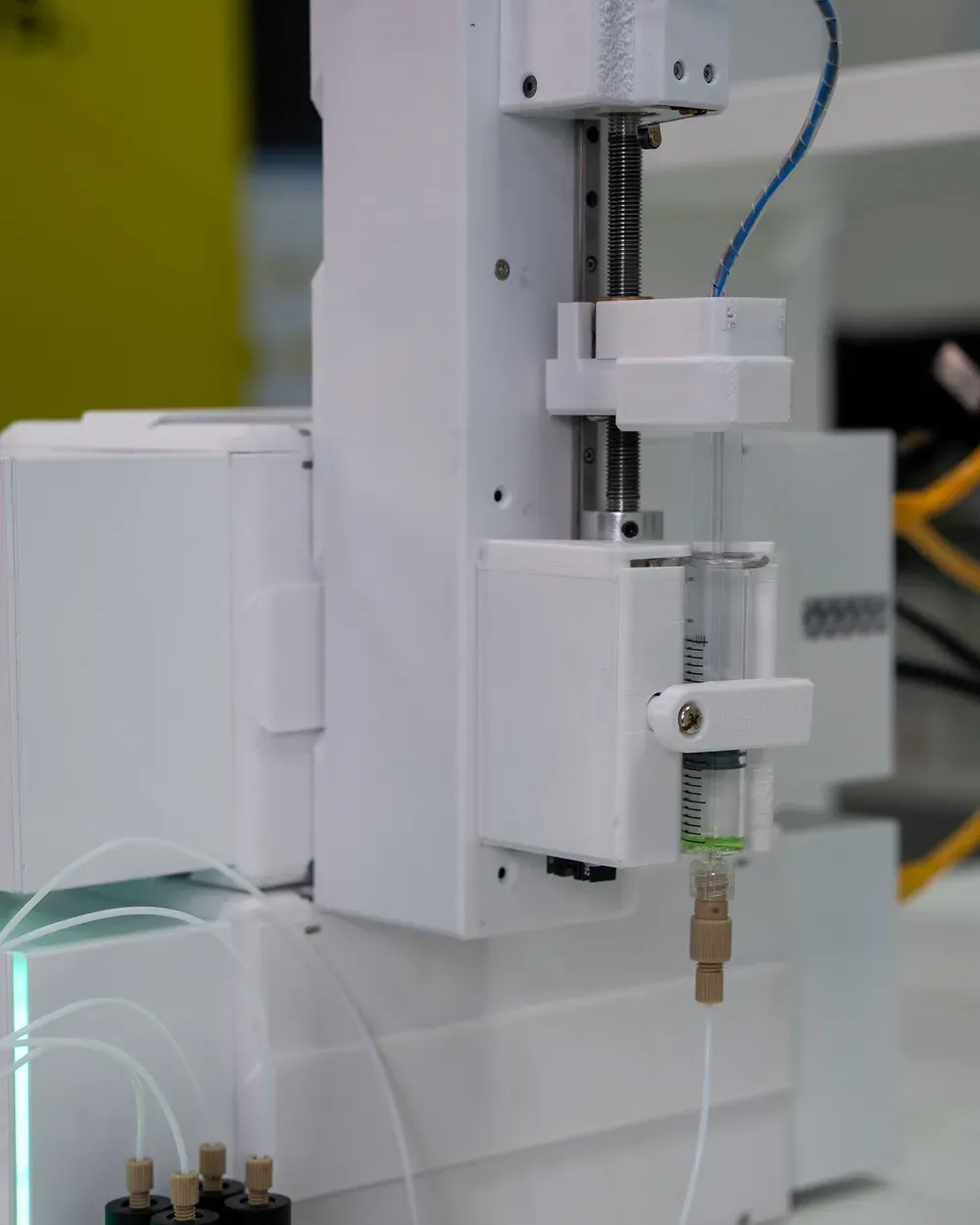
- QB Syringe Pump SPM-002 60 × 240 × 120 mm datasheet lists 240 × 60 × 120 without syringe; drawn upright
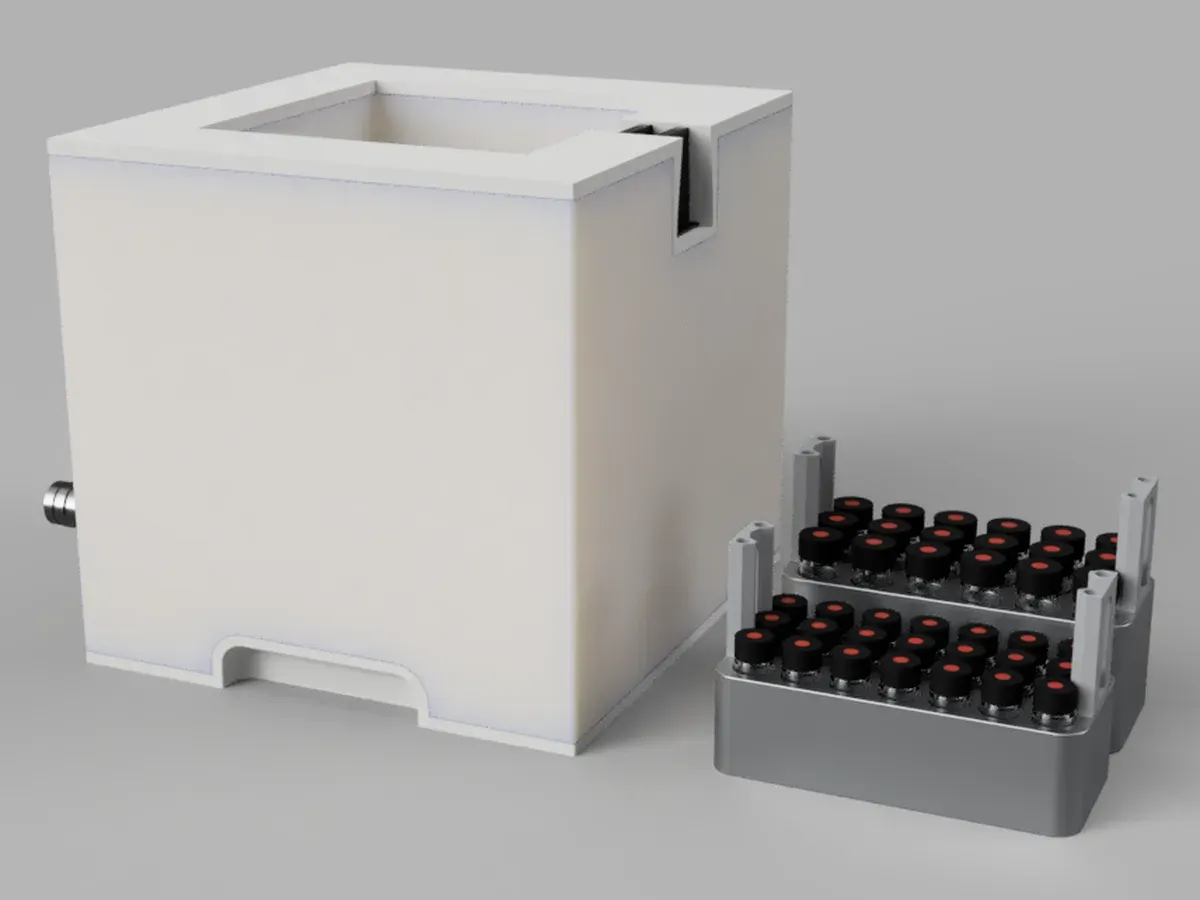
- QB Sample Cooling Chamber SCM-001 (optional) 237 × 273 × 232 mm optional, dashed; samples can also go straight into vials. Draft datasheet; 278 mm deep with connectors
- QB QB Thermo TCT-001 chiller (optional) 345 × 248 × 215 mm optional, dashed; axis order not stated, orientation indicative
- Eppendorf Bioprocess Autosampler, single head 1768 × 1400 × 795 mm overall system; 45 kg excluding control system and PC; dual head is 2168 mm wide
QB sizes are from the QB datasheets (the SCM-001 datasheet is a draft). Eppendorf sizes are from the Eppendorf Bioprocess Autosampler brochure (Copyright 2026), where they are listed as W × D × H and shown here as W × H × D.
Summary
The two systems are built for different starting points. The Eppendorf Bioprocess Autosampler is integrated in DASware control software and is built for labs that run Eppendorf bioreactors (DASbox, DASGIP, SciVario twin, BioFlo 320 / 320 plus). It stores up to 648 samples in tempered vials, can transfer cell culture samples directly to a Nova BioProfile FLEX2 analyser, and lists “feedback loop control from analyzer results” as a feature [S7]. The QB AutoSampler is a modular, software-defined sampling path (syringe pump, selector valve, QB Edge, QB Control services and recipe engine) with configurable wash, rinse and air-dry legs, recipe-driven triggering, cooled vial storage, in-vial dilution up to a factor of 6 and split aliquoting between two ports [QB-K, QB-C].
Choose QB AutoSampler when
- Mixed-vendor equipment, with port compatibility confirmed per case
- A recipe-driven sampling path configured in software (wash, rinse and air-dry legs, scheduled or conditional triggers)
- In-vial dilution up to a factor of 6 or a split of one draw between two ports
- Cooled vial storage at 4 °C while the temperature control service runs
Choose Eppendorf Bioprocess Autosampler when
- Eppendorf bioreactors (DASbox, DASGIP, SciVario twin, BioFlo 320 / 320 plus) with sampling inside DASware control
- Direct transfer of cell culture samples to a Nova BioProfile FLEX2 analyser
- Control actions based on analyser results (feedback loop control listed on the product page)
- Tempered storage of up to 648 samples in 1.5 mL and 10 mL vials
New to automated sampling? Our guide to automated aseptic bioreactor sampling explains how samplers work and how to choose one. Full details of the QB system are on the QB AutoSampler page.
Side by side
Control software
QB Control services and recipe engine on QB Modules
Integrated in DASware control software
Bioreactor scope
No list of verified bioreactor interfaces published; confirm per case
Eppendorf bioreactors listed; other vessels not listed
Sample storage
Cooling chamber: 42 × 4 mL, 36 × 8 mL or 21 + 18 mixed vials; cooling only while the service is in Execute
Up to 648 samples in tempered vials, 4–40 °C
Dilution
In-vial, factor 1.0–6.0, no mixing
Not described for the sampler
Analyser-driven control
None documented
Feedback loop control from analyser results listed
21 CFR Part 11
Conformance features; electronic signatures not yet covered (in development, no committed date)
Not stated
How each sample path is built
Sources
Core
Destinations
Schematic of the documented path, not to scale.
Sources
Core
Destinations
Schematic of the documented path, not to scale.
Each table below keeps the evidence label of the source: C QB Systems documentation and platform behaviour; K QB product documentation; O owner statement, not verified in code; M manufacturer page or data sheet; T third-party report; U unverified or not re-checked. “Not stated” means the reviewed source does not say; it does not mean the feature is absent.
At a glance
| Dimension | QB AutoSampler | Eppendorf Bioprocess Autosampler |
|---|---|---|
| Control software | QB Control services and recipe engine on QB Modules | Integrated in DASware control software |
| Bioreactor scope | No list of verified bioreactor interfaces published; confirm per case | Eppendorf bioreactors listed; other vessels not listed |
| Sample storage | Cooling chamber with 42 × 4 mL, 36 × 8 mL or 21 + 18 mixed vials; cooling only while the service is in Execute | Up to 648 samples in tempered vials, 4–40 °C |
| Dilution in the sampler | In-vial, factor 1.0–6.0, no mixing, ratio accuracy not specified | Not described for the sampler |
| Analyser-driven control | None documented | ◆ Feedback loop control from analyser results listed |
| Triggers | Scheduled and recipe-conditional; external trigger through OPC UA | Predefined times or events through scripting |
| 21 CFR Part 11 | Conformance features; electronic signatures not yet covered (in development, no committed date) | Not stated |
1. Sources and modularity
| System | Maximum sources as stated | Modularity as described by the vendor | Source | Evidence |
|---|---|---|---|---|
| Eppendorf Bioprocess Autosampler | Depends on the bioreactor system: DASbox up to 16, DASGIP up to 16, SciVario twin up to 8, BioFlo 320 up to 4 | Integrated in DASware control; bolus addition is an optional add-on | S7 | M |
| QB AutoSampler | Selector Valve with up to 24 positions, shared between source, wash, air, waste and destination ports; valves stackable; no fixed vessel maximum documented | QB Modules on one QB Edge (7 PoE ports, more via QB Switch); shared, dedicated or combined paths; scaling by adding valve and pump pairs plus a licence upgrade | QB | C (valve range of 24, port roles); K (QB Edge); O (stackable valves, scaling by pairs and licence upgrade) |
Valve positions are not sources, so the 24 positions of the QB Selector Valve are not compared with the Eppendorf source counts. The Eppendorf product page lists Eppendorf bioreactors only and does not list other manufacturers’ vessels, so labs with mixed fleets should ask Eppendorf directly [S7]. QB Systems has not published a list of verified bioreactor interfaces; confirm port compatibility per case [QB-O].
2. Sample destinations and transfer to analysers
| System | Destinations as stated | Source | Evidence |
|---|---|---|---|
| Eppendorf Bioprocess Autosampler | Tempered storage in vials, or direct transfer to a Nova BioProfile FLEX2 analyser | S7 | M |
| QB AutoSampler | Vials, analytical devices and waste are destination types; the number of destinations is limited by the valve positions; no specific analyser integration or maximum number of analysers is documented | QB | C (port roles); O (destination types) |
The Eppendorf page lists analyte outputs such as glucose, lactate, glutamate, cell density and viability, osmolality, pH, pCO2 and pO2 for the FLEX2 analyser [S7].
3. Sample storage
| System | Storage as stated | Source | Evidence |
|---|---|---|---|
| Eppendorf Bioprocess Autosampler | Up to 648 samples; 1.5 mL and 10 mL vials; tempered 4–40 °C | S7 | M |
| QB AutoSampler | QB Sample Cooling Chamber SCM-001 with external chiller loop: 4 °C for more than 72 h (only while the service is in Execute); 1 °C minimum reached in laboratory conditions; roughly 10 min to 4 °C in a pre-cooled chamber, roughly 20 min from a room-temperature chamber; 42 × 4 mL, 36 × 8 mL or 21 + 18 mixed vials per chamber; 4 mL vials hold max. 3 mL, 8 mL vials max. 6 mL | QB | K (holders, cooling times, 1 °C minimum); C (TCU service behaviour); O (more than 72 h at 4 °C, vial figures) |
Cooling in the QB AutoSampler runs only while the Temperature Control by TCU service is in Execute. The TCU stops, and cooling stops, when the service is paused, held, stopped, completed or aborted, when the message bus connection is lost and when the service restarts; a lost or bad sensor signal also leaves the service on hold with the TCU stopped. For continuous cooling the service must stay in the Execute state, so plan for this when samples must stay cold unattended [QB-C].
4. Sample volume and cleaning
| System | Sample volume as stated | Cleaning / aseptic features as described by the vendor | Source | Evidence |
|---|---|---|---|---|
| Eppendorf Bioprocess Autosampler | Low dead volume stated, no figure | Septum-sealed ports; ethanol sanitation similar to manual sampling; aseptic operation without a laminar flow cabinet | S7 | M |
| QB AutoSampler | 1.0–6 mL recommended (6 mL requires the 10 mL syringe); dead volume 0.5–1.0 mL; path accuracy approx. ±0.5 mL; with the known limitation that a second-aspiration volume plus sample above the syringe volume gives a smaller sample without a warning | Configurable wash (N), rinse (N) and air-dry legs plus optional path fill (“wash after sample” on by default); Sampler Cleaning Service for selected valve ports; aseptic setup (owner statement, no document seen) | QB | C (service behaviour, known limitation, cleaning); O (volume range, dead volume, path accuracy, aseptic set and SOP) |
Comparable dead-volume and path-accuracy figures were not found in the Eppendorf public source, so no conclusion is drawn either way [S7]. For the QB AutoSampler, the aseptic setup consists of dedicated consumable sets, an A4BEE-provided SOP for assembly and operation, and an aseptic testing report available on request [QB-O].
5. Sample preparation: dilution and splitting
| System | Dilution | Splitting / distribution | Source | Evidence |
|---|---|---|---|---|
| Eppendorf Bioprocess Autosampler | Not described for the sampler; the FLEX2 analyser documents onboard dilutions | Transfer to FLEX2 or vials | S7, S11 | M |
| QB AutoSampler | Sampling Dilution Service: in-vial, dilution factor 1.0–6.0 (total ÷ sample); chase principle with air chase; no mixing; ratio accuracy not specified; sample at least 1 mL when diluting; one destination per run; operator enters the usable vial volume | Sampling Aliquoting Service: one draw to two ports, sequential (Y to port A, rest Z to port B; Z = 0 allowed); operator-entered dead volumes compensated, lines assumed empty; delivered volumes derived from the pump’s remaining volume; warning above the larger of 0.05 mL and 2 %; no numeric accuracy specified; no process limits specified | QB | C (QB Systems documentation) |
6. Sampling triggers and control
| System | Triggers and control as stated | Source | Evidence |
|---|---|---|---|
| Eppendorf Bioprocess Autosampler | Predefined times, or events through the scripting feature; “feedback loop control from analyzer results” listed | S7 | M |
| QB AutoSampler | Scheduled and recipe-conditional sampling with the Automated Sampling service using live device tags, timers, counters, variables and signals; OPC UA server for external clients; external trigger of sampling through the OPC UA connector; services publish status events for external clients; no feedback control from analyser results documented | QB | C (recipes, OPC UA server, MQTT); O (external trigger of sampling through OPC UA; no sampling-specific mapping was found in the code) |
Confirm with QB Systems how an external trigger through the OPC UA connector is set up for your control system [QB-O].
7. Data integrity and licensing
| System | Electronic records / Part 11 | Licence statements | Source | Evidence |
|---|---|---|---|---|
| Eppendorf Bioprocess Autosampler | Not stated | Not stated | S7 | M |
| Nova BioProfile FLEX2 (analyser, not the autosampler) | The analyser page states GMP and 21 CFR Part 11 support with audit trails, electronic records and OPC | Not stated | S11 | M |
| QB AutoSampler | Audit trail (incl. Batch Run and Recipe Audit Trail reports, recipe import / export, safety actions, service outcomes) and PDF batch reports, “Sampling basic” report; QB Control conformant with the Part 11 requirements it implements (owner statement); electronic signatures not yet covered (in development, no committed date) | Licence tiers BASIC / ADVANCED / PRO with validity dates and expiry warnings; per-service licence entries; perpetual or fixed-term licence, to be confirmed with QB Systems; 12 months of remote support included; competitor terms not published in the sources reviewed | QB | C (audit trail, reports, tiers, expiry warnings); O (conformant wording, licence term, 12 months support) |
The Nova FLEX2 row describes the analyser that the Eppendorf autosampler can feed, not the autosampler itself [S11]. QB does not claim compliance or validation, which is a property of the user’s validated process. The QB AutoSampler is positioned as non-regulated research and process-development tooling.
Where the QB AutoSampler has limits
- Dilution is in-vial only, up to a factor of 6, without mixing and without a specified ratio accuracy.
- Splitting a draw goes to two ports, one after the other.
- Analyser transfer. Analytical devices can be allocated as destination ports, but QB documents no specific analyser integration and no maximum number of analysers [QB-O].
- Volumes. Dead volume of 0.5–1.0 mL per sample and a path accuracy of approx. ±0.5 mL are disclosed. A known limitation of the Automated Sampling Service: the tube receives the second-aspiration volume plus the sample volume; if this exceeds the syringe volume, the draw ends with a full syringe and less sample is taken, without a warning [QB-C].
- Cooling continuity. Cooling runs only while the Temperature Control by TCU service is in Execute [QB-C].
- Process limits and alarms. Sampling Aliquoting has no process limits and no six-level alarms [QB-C].
- Feedback control. QB documents no control driven by analyser results; the Eppendorf page lists feedback loop control from analyser results [S7].
- Bioreactor connection. QB Systems has not published a list of verified bioreactor interfaces, and compatibility with the Flownamics FISP probe has not been tested [QB-O].
- Positioning. The AutoSampler is positioned as non-regulated R&D and process-development tooling. QB Systems is a newer entrant in dedicated bioprocess sampling, and the source article cites no application data for the AutoSampler.
- Integrations. No LIMS / ELN integration is documented [QB-O].
Making the decision
- Bioreactor ecosystem. If you run Eppendorf bioreactors and want sampling inside DASware control, the Eppendorf autosampler is built for that. If you have mixed equipment, ask every vendor for a written list of verified bioreactor interfaces.
- Where samples go. Eppendorf transfers directly to a Nova BioProfile FLEX2 analyser or stores samples in vials. If samples are collected cold for later offline analysis, compare storage temperature, vial counts, the sampling volume taken from the vessel, and whether cooling continues in every service state.
- Analyser-driven control. Eppendorf lists feedback control from analyser results; QB documents none.
- Assurance and records. Ask each vendor what aseptic documentation they supply, and whether audit trails, reports and electronic signatures are available as shipped functions. The QB AutoSampler provides an audit trail and PDF reports; electronic signatures are not yet covered (in development, no committed date).
- Growth. Ask what each step of growth requires: more devices, more licences, vendor service or lab staff, and whether running sampling has to stop. For the QB AutoSampler, adding sources or destinations means adding valve and pump pairs and a licence upgrade [QB-O].
The full analysis, including Securecell Numera, Flownamics Seg-Flow and Merck MAST, is in the article The state of benchtop automated sampling in bioprocessing: a comparative analysis for 2026.
Sources
| ID | Source | URL | Retrieved |
|---|---|---|---|
| S7 | Eppendorf, Bioprocess Autosampler | https://www.eppendorf.com/us-en/Products/Bioprocess/Bioprocess-Controllers/Bioprocess-Autosampler-p-PF-7778759 | 19 Oct 2026 |
| S11 | Nova Biomedical, BioProfile FLEX2 | https://www.novabiomedical.com/cell-culture-analyzers/bioprofile-flex2/ | 19 Oct 2026 |
| ID | QB source |
|---|---|
| QB | Umbrella ID in the Source columns of the tables; the Evidence column states which of QB-C, QB-K or QB-O applies |
| QB-C | QB Systems documentation and platform behaviour; state of 14 October 2026 |
| QB-K | QB product documentation 09.2026 |
| QB-O | Statements of QB Systems (product owner), not verified in the product code |
Legal Notice & Disclaimer
1. Publisher and transparency. This document is prepared and published by A4BEE Sp. z o.o. (Poland), which develops and sells QB Control and QB Modules under the QB Systems brand. A4BEE has a commercial interest in the products compared. The comparison is intended to highlight objective differences; it is not an independent test or review.
2. Nature of the comparison. This document is comparative information within the meaning of Directive 2006/114/EC. It compares products that meet the same needs or are intended for the same purpose, and addresses material, relevant, verifiable and representative features. It is not intended to discredit or denigrate any company, product or trademark, to create confusion between brands, or to take unfair advantage of the reputation of any trademark.
3. Basis, date and versions. The information on third-party products is based on publicly available sources listed under Sources, gathered on or before 19 October 2026, and refers to the Eppendorf Bioprocess Autosampler. QB AutoSampler information refers to the sampling services of QB Control (state of 14 October 2026). Products, features, versions, licensing terms and documentation change over time. Where a feature is described as “not stated”, this means it was not found in the public sources reviewed; it does not mean that the feature does not exist. Readers should verify current information directly with each vendor before making any decision.
4. Evidence labels and methodology. Each statement carries the source of the information and an evidence label (C, K, O, M, T, U, as explained in the introduction). This document contains no ratings or scores. Statements of QB Systems labelled O are owner statements that have not been verified in the product code. The comparison is not exhaustive and may omit options or configurations.
5. No prices, no offer, no warranty. This document intentionally contains no prices. Nothing in it is an offer, quotation, specification or contractual commitment, and nothing in it constitutes a warranty of fitness for a particular purpose. QB Control capabilities depend on the software version, licence tier (BASIC / ADVANCED / PRO), configuration and connected hardware. Binding terms apply only under a signed agreement with A4BEE Sp. z o.o.
6. Regulatory statements. Statements about FDA 21 CFR Part 11, EU GMP Annex 11, GAMP 5, ISA-88, ISA-18.2 or other standards describe product features only. They are not certifications, legal or regulatory advice, or a guarantee of compliance. Compliance, validation and the GAMP categorisation of any computerised system remain the responsibility of the regulated user. QB Control provides 21 CFR Part 11 conformance features (electronic records, audit trail, access control, user management); electronic signatures are not yet covered. The QB AutoSampler is intended for non-regulated research and process development.
7. Forward-looking statements. Any reference to future development is a statement of current intent only, not a commitment, and may change without notice.
8. Trademarks. All trademarks, logos and brand names are the property of their respective owners. They are used only to identify the products compared (nominative use). Their use does not imply any endorsement by, affiliation with, or sponsorship from their owners. Trademark symbols (® / ™) follow the owners’ own usage as far as known. QB Systems, QB Control, QB AutoSampler and QB Modules are brand names of A4BEE Sp. z o.o.
9. Limitation of liability. This document is provided “as is” for general information. To the maximum extent permitted by applicable law, A4BEE Sp. z o.o. accepts no liability for errors or omissions, or for any loss or damage arising from reliance on this document or from decisions made on its basis.
10. Corrections. If you believe any statement about your product is inaccurate or out of date, please contact [email protected] with supporting information. A4BEE will review the request promptly and correct or remove inaccurate content.
11. Copyright. © 2026 A4BEE Sp. z o.o. This document may be shared only in full, unmodified, and together with this notice.
Competitor information in this document comes from the public vendor pages and third-party pages listed under Sources, retrieved on 19 October 2026. Vendors may change specifications at any time; “not stated” means the reviewed source does not say, not that a feature is absent. The document is not exhaustive and may omit options or configurations. Confirm all specifications and commercial terms directly with each vendor. QB Systems supplied the specifications of the QB AutoSampler (QB Systems documentation and statements of QB Systems, labelled in the evidence column); competitor data was collected independently from the sources cited. Corrections from vendors are welcome at [email protected]. The QB AutoSampler is intended for non-regulated research and process development; electronic signatures are not yet covered (in development, no committed date).